Fibre-rich plants foods, such as fresh fruit and vegetables, seeds, nuts, beans, peas, and lentils are all packed with vitamins, minerals and fibre. Eating sufficient portions of these as part of our everyday diet will encourage a healthier digestive system. These nut clusters make for a tasty treat while still providing us with essential nutrients.
I’ve used a bag of mixed nuts, but any combination of plain, raw nuts can be used, and any chocolate of choice too; dark, milk, white, or plant based. They keep well in a sealed container in the fridge for up to five days; perfect to make today and enjoy as an afternoon pick-me-up for the week.
Preheat the oven to 190°C / fan 170°C / Gas Mark 5. Place the nuts on a baking tray and into the oven for about 7 minutes.
Take from the oven and once cool enough to touch, roughly chop the nuts and place in a bowl. Add the honey and sea salt. Stir well to combine.
Divide the mixture between a 12-case silicone bun case, or into a regular 12-case bun tray lined with bun cases. Bake in the preheated oven for 15 minutes. Allow to cool and set fully before removing from the tray.
Once the clusters are cold, remove from the tray and dunk in the melted chocolate. Sprinkle over a little sea salt and leave to set before storing in an airtight container in the fridge for up to five days.
Summer salads have been catapulted back to the dinner table and I for one am glad they are here to stay, especially as the stunning sunshine we have been enjoying is set to remain in Ireland for the foreseeable. This salad is high in fibre and rich in protein. It’s packed with vibrant vegetables, and the creamy, zesty dressing brings everything together so perfectly. Serve it alongside any barbecue dishes, or simply with a nice bread, crackers, or tortilla chips. It’s best eaten on the day it is made but will store well for up to three days in a sealed container in the fridge.
Preheat the oven to 220°C/fan 200°C /Gas Mark 7, or if using an airfryer set to 200°C.
Add the chickpeas to a bowl with the olive oil, maple, paprika and a little salt and pepper. Combine well and place on a baking tray and into the preheated oven for 20-22minutes, giving the tray a shake every so often. Leave to cool fully before adding to the other salad ingredients.
Add the finely prepared vegetables to a large bowl with the cold chickpeas.
Make the creamy dressing by adding the dressing ingredients to a mini chopper and blitzing gently for a few seconds to combine.
Pour the dressing over the vegetables and chickpeas. Stir well to combine. Refrigerate until ready to serve. Enjoy!
My feeling when it comes to pesticide residues in our food is that the only safe limit is a zero limit. If I were to tell you that 50% of the food you eat contains pesticide residues, how would you feel?
My Grandad farmed on this piece of land that we now farm organically. He had a mixed family farm and grew much of his own food as did many in the locality back then. This food was more nutritious, it tasted better, it was fresher than food today, it was free from chemicals, and it was local and seasonal.
Today our food system is a complex web of producers, processors and logistics. When we walk into a supermarket, we don’t have time to think too much about where our food comes from our how it was produced, the shiny plastic packs of produce give us the impression that our food system is limitless, vibrant and fair. Indeed, this very supermarket system and the global food corporations that supply it have disconnected us from our food and have been complicit in devaluing our most valuable commodity: food.
Since my grandad’s time in the early 1950’s agriculture and food have changed unrecognisably. It has undergone a green revolution. Ironically this “green revolution” has left our current food system broken. GMOs, giant monocultures, pesticides, herbicides, artificial fertilisers and factory farms dominate our global food supply system, all hidden behind those shiny plastic packs on the supermarket shelves.
The term “green revolution” was always something that struck me as a bit odd, especially when you consider what green means today, this was a revolution that switched our agricultural system from a natural approach to a chemistry centred approach.
I am an organic farmer, but I wasn’t always. In fact, and again ironically, I was an organic chemist, I have a Ph. D in chemistry from Cambridge University. I spent nearly 15 years working with chemicals, pharmaceuticals and in the biotech industry, so I know a thing or two about chemicals.
Today chemicals are used to force nature to behave in the way they want, they have tried to impose factory type controls onto the natural environment that we rely on for our food. But nature is not a factory, and the same rules do not apply, you cannot indiscriminately apply chemicals to our food and not expect a fall out.
A report by the European Food Safety Authority (EFSA) has found that nearly half the food they tested from almost 81,000 food samples had pesticides in them. Strawberries and lettuce are the most likely to exceed safe limits, the agency found. They are especially sensitive to fungus and bugs and so undergo considerable spraying with pesticides.
More than one in four (27.3%) of the food samples contained traces of more than one pesticide.
The food we put into our bodies is one of the most valuable investments we can ever make. The simple fact is you can taste value, and if you have ever tasted a freshly harvested tomato, warm from the vine, free from chemicals, full of life and nutrition, then you will know what I am talking about here, that is real value. I think my grandad instinctively knew that, but then again that was all there was back then.
Here is to the best value food in the world.
As always thank you for your support.
Kenneth
Link to report below.
A new report by the European Food Safety Authority (EFSA) has found that more than 97% of foods contain pesticide residue levels that fall within legal limits. Strawberries are the most likely to exceed safe limits, the agency found.
About 55% of the samples evaluated by EFSA were free of detectable traces of these chemicals, the agency said.
This means nearly half of food products in Europe contain residues of pesticides.
The highest rate of exceeding safety limits was for strawberries (2.5% of the sample), followed by lettuce (2.3%). They are especially sensitive to fungus and bugs and so undergo considerable spraying with pesticides.
The late spring, early summer season brings with it the return of many Irish-grown vegetables. Irish mushrooms are a constant as they thrive in darkened conditions allowing them to grow year-round, but luscious salad leaves and herbs are always encouraged by the better weather. I’d happily serve a plain green salad alongside any meal, but when a little light balance is required on a plateful of indulgent bites Irish salad leaves, simply dressed with some lemon and olive oil, are always well placed.
These crispy garlic mushrooms make for a gorgeous starter or light supper. They can be prepared early in the day, and stored in the fridge, until ready to bake. I like to use the flatter, portobello mushrooms, but chestnut mushrooms can be used either in their place. To serve, I’ve mixed together some mayonnaise with a crushed garlic clove, a little lemon juice, black pepper and freshly chopped chives, as a flavoursome accompaniment.
Our food is probably one of the most valuable investments we can make, and our decisions affect us deeply, and over time they take their toll. Look at the rise of obesity, diabetes, and other chronic inflammatory disease.
The long-term impact of consuming too much sugar, or ultra processed foods is clear, but what is less clear is the cumulative impact of the pesticides and herbicides that are endemic in our food, the hidden extras that we never see.
What is the impact of the small amounts of pesticides we consume in our food daily, the cocktail effect of these chemicals over a period of years can be profound.
What if our organic kale was just kale, and the conventional chemical sprayed kale had to be called “chemical kale” ? Our impression of food would change our realisation that our food is grown with chemicals would be clear. We may then consider their impact on our health, or how our food choices impact biodiversity.
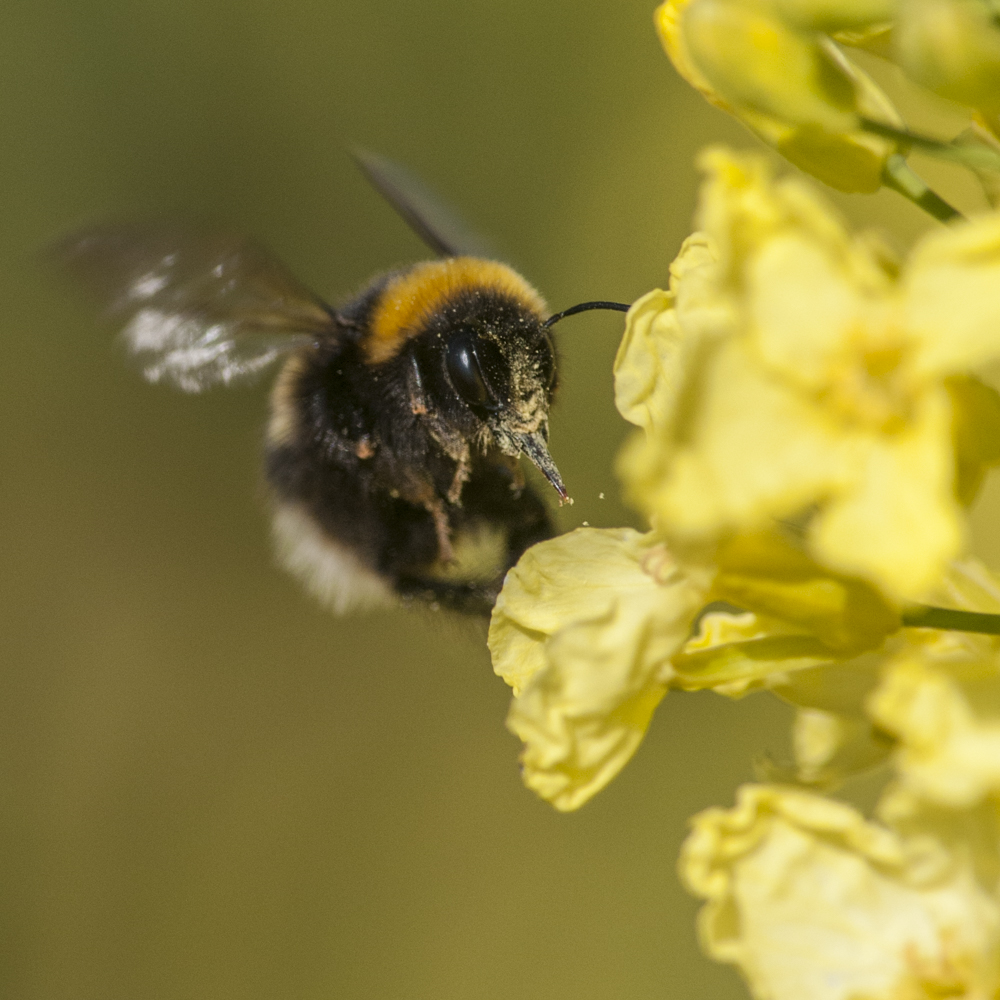
At the moment our kale fields are bursting with flowers, and bees and biodiversity. They are also covered in aphids, as the kale is at the end of the season they are doing little harm. These aphids in conventional systems only a few years ago would have been treated with neonicotinoid chemicals, these systemic chemicals were shown to kill bees. The chemical industry denied and lobbied against groups that wanted them banned, knowing full well they were killing the bees. Thankfully these chemicals are now banned.
We have just been designated as a conservation area for the native Irish honey bee, the bee hives that Gerry manages on our farm are native Irish honey bees and these bees are, as all bees are under threat from habitat destruction, the relentless intensification of agriculture, the loss of biodiversity and the overuse of chemicals in our food chain. The Irish honey bee is unique to Ireland and it needs to be protected. Our food choices directly impact Gerry’s honey bees, in this case in a very positive way, and they are thriving on our farm.
Not only do our food choices, impact our food, but it seems they also impact the quality of our drinking water. Irish water this week announced that they have found 66 exceedances of what they deem is the safe limit of pesticides in our water. I would argue that the only safe limit is a zero-tolerance limit. A senior manager said:
“We want to remind users to be mindful of water sources when using pesticides, as one drop of pesticide can be detected in a stream up to 30km away.”
Chemicals found included MCPA (used to kill rushes), 2,4-D (this was a chemical found in the notorious agent orange concoction sprayed to defoliate forests during the Vietnam war). And of course glyphosate, the main ingredient in all-purpose Roundup makes a star appearance, which is no surprise.
But as with Gerry’s bees, our food choices really do matter, they drive a different type of food production, they change the laws of the land, they get chemicals banned. So, the next time you are choosing food, if there is an organic option, maybe if you can choose that, it really matters.
There are several dishes which can be created or elevated with leftover mashed potato; from a salad to a comforting pie-topper, there are so many possibilities for this humble staple. If you’re faced with a bowlful of leftover mash, I would however highly recommend you transform it into these delicious chive and cheese potato bites. They only take minutes to prepare and can be served as a dinner accompaniment or simply enjoyed as a snack. Any hard cheese of choice can be used, dairy or plant-based, but ensure it’s very finely grated, allowing it to incorporate well with the potato. Chives are back in season, and I love to add them wherever a little onion scent is required in a dish, but finely sliced scallions can also be used in their place. I like to mirror the flavours in the bites with a garlic and chive dip, but any dip of choice can be enjoyed alongside these crispy bites.
Add the mashed potato to a large bowl with the flour, finely grated cheese and chopped chives. Stir well to combine. Take a spoonful of the mixture and roll it into a ball. Continue until all the mixture has been used, making about 20 potato bites. Place on a plate and into the fridge to set for a couple of hours.
When ready to cook, place a large frying pan over a medium heat. Add a thin layer of cooking oil, sunflower or olive, and once hot, fry the potato bites for about 5 minutes on each side, turning occasionally while frying.
Transfer to a paper lined plate, then to a serving plate. Sprinkle with a little sea salt, a grating of hard cheese and some finely chopped chives. Enjoy immediately.
Why do we have to call our carrots “organic carrots”, whilst carrots grown with chemicals get to be called “carrots”. We have two organic certification inspections every year to prove that we are doing what we say we are doing.
We must pay for the privilege to demonstrate we are doing the right thing. When you think about it, it doesn’t seem right. And yet as aside it is the world we live in. If you do not know your food producer, then to be sure that your food is chemical free, organic certification is the only way to get food you can trust.
But why is it that chemical usage on our food is the norm and we need to demonstrate we are different because we don’t use chemicals?
I want to call our carrots, just carrots. It changes the narrative, it makes you stop and think, we are farming without chemicals and yet we must prove that we are not using chemicals.How would our mindset change, if when we picked up a pack of carrots in a supermarket they were labelled “chemical carrots”. Well, I would hazard a guess that fewer packs of these carrots would be picked up and more organic carrots would.
Fresh produce did not used to be differentiated, there was just carrots. But the organic label was coined to give people a choice to opt for not consuming toxic chemicals with their food. This only really became an issue as the prevalence of synthetic chemicals in our food chain grew. I am taking here about the generation of pesticides that were developed from the 1960s on and created a whole new multibillion dollar industry built on agrichemical control of our food. Modern synthetic fungicides, pesticides and herbicides are in and on our food, some are systemic in nature, others damage the soil, biodiversity and of course our health.
Although recently things have improved in the conventional world of food production and IPM (integrated pest management) is being used. But chemicals are still the easiest solution, they are less work, and they are still used intensively both here in Ireland and abroad. In 2015, the last date there is reliable data for pesticide use in Ireland by crop, 660 Ha of carrots were grown and they received, 2,856 kilogrammes of pesticides, that is 1.73kg per acre, that is quite a lot of chemicals.
Common chemicals that are used in conventional carrot production are shown below and so if we were to list the chemicals on the produce label, it might look something like this:
Or you can choose organic carrots which would state:
Carrots (may contain: carrots)
I know which one I would choose.
As always thanks for your support. Kenneth
PS check out the little video I made out in our field of kale flowers that are buzzing with bees and insects, it is a haven for biodiversity, it is amazing and beautiful and reminds us that we may be doing something right. This is one of the reasons we do not use chemicals on our food and farm.
The next time you drive down the motorway, check your windscreen, it will be devoid of insect splatter, only 20-30 short years ago that used to be a completely different story. Here is something different to think about when we think about the disappearing insects, of course the insecticides are destroying whole ecosystems, but what about herbicides?
The dandelions are up in force. But consider this, next time you see a field of grass that is generally being grown to be fed to dairy cows, see how many dandelions you see, or in fact see how much of anything other than grass you see. I think you will find that there is very little. Grassland is produced to be a giant monoculture, and it is considered best practice to remove all diversity from these fields, to feed Ireland’s massive dairy industry.
But it didn’t always used to be like this, dairy cows in a not-too-distant past fed on mixed pasture. The irony of course is that a diverse array of plants access different levels of the soil and so bring up different nutrients and give a more balanced diet to the animals, providing a virtual plant salad bar for animals and supported a whole ecosystem, one a ryegrass-dominated monoculture never will.
The diversity today is removed by spraying herbicides, a typical spraying regime for grassland will involve an array of different chemicals. One that is actively used right here in Ireland goes by the tradename “Thurst” and it contains: 2,4-D + Dicamba. You may have heard of herbicides like 2,4-D before, it is one of the most common chemical weedkillers used in conventional farming. It’s designed to kill broadleaf weeds like dandelions without harming the grass. While it works effectively, it comes with a history and environmental impact that we’re not comfortable with.
👉 Did you know? 2,4-D was one of the ingredients in Agent Orange, the defoliant used in the Vietnam War. While modern formulations don’t contain the toxic contaminants that caused so much harm back then, 2,4-D is still a synthetic chemical. It can linger in soil and waterways, and it’s been classified as “possibly carcinogenic to humans” by the World Health Organization.
This is just one of a handful of chemicals that are used to keep grasslands, green, full of grass, and absent of biodiversity. Giant monocultures whether they be GM soya crops grown in the US or giant fields of grass grown in Ireland are food deserts for insects, there is nothing for them there, no weeds, no flowers, no food. The chemicals themselves that act on the plants are removing a crucial piece of our ecosystem that has a knock-on effect all the way up the food chain. We hear a lot about bees, and bee populations have been devastated over the last 20 years, but the bees are a bell weather for the insect population as a whole. If insects and bees go, well then the omen is not too good for us humans.
But there is hope, farmers more and more are incorporating clover into their grass swards and there is increasing demand for organic food which protects not only our health but biodiversity too. Our food choices matter, keeping chemicals out of our food matters, and they make a huge difference, they send a powerful message and can effect real change.
As always thank you for supporting our farm and business.
Kenneth
p.s We would ask you to support us over Easter week if you can. Thank you to everybody who did this week it made a real difference. And we hope if you ordered bread that you enjoyed the amazing Carraig Rua breads that we will have every week from now on!
A crispy biscuit base, topped with caramel, sliced banana, softly whipped cream, plus a few little chocolate eggs, makes this Banoffee Pie a deliciously indulgent dessert to serve this Easter.
To aid with the setting of the biscuit base, I like to bake it for just a few minutes. The dairy-free caramel is thick and creamy, and few ingredients are needed, but it is essential to blitz well for a few minutes to achieve that smooth consistency. While the topping of white billows of softly whipped cream looks so impressive, a light dusting of cocoa powder and a few Easter treats makes this the perfect pie to enjoy over the Easter holidays.
Using a food processor, blitz the digestives until fine. Stir through the melted butter until well combined. Tip into a well-greased 23cm loose bottomed tart tin, and cover the base and sides with an even layer, pressing into place with the back of a spoon. Place in the preheated oven for 8 minutes.
While the base is in the oven, make the caramel by adding the caramel ingredients to a high-powered blender and blitz until completely smooth, which will take a few minutes.
Once the base is taken from the oven, evenly spread the caramel over the base and leave to completely cold and set before moving on to the next step.
To assemble, top the cooled caramel with the sliced banana, then evenly add dollops of the cream, before dusting with a little cocoa powder and adding a few little chocolate eggs. Cover and refrigerate until ready to serve. This pie is best eaten on the day it is made.
Rumi said, “As you start to walk on the way, the way appears” Clarity doesn’t come before action, it comes from action. After many weeks of planning, we are finally ready to start.
This business that we find ourselves in, seems to always be grinding away at one’s soul, it is hard.
Growing vegetables commercially is hard, growing vegetables without chemicals is harder, and selling produce as a small business might even be harder still. But at other times like the week just gone when the sun shines and the birds sing and the bees finally wake up from their winter slumber, it gives back.
Sometimes it is hard to get perspective especially when you are in the thick of things and we all make mistakes. Anyway, amidst the usual weekly turmoil something stuck me, you can’t do it on your own, life, business, relationships, you need help and support.
I am grateful for the team of individuals (and this includes you our customers) that have chosen to pitch in with us, without them it would be a very different affair, but because of them and their dedication we have an amazing, vibrant, sustainable business.
Collaboration is key, it has always been something we have stuck by, and I am not saying I or we are perfect, far from it, and there is plenty of times when stress or general goings on means we miss the boat, we say or do things which would have been better not said or not done. But fair collaboration is what in an ideal world we strive for, whether that be with our customers or suppliers or anybody who touches on our business, collaboration I’d go so far as to say it is the only way.
During the past number of months, I have had the fortunate experience to begin a conversation with Liam Gavin from Drumanilra farm, he also runs Carraig Rua bakery. The aim of our conversations was to get the best most amazing, sustainable, organic, slow fermented over 48 hours bread to you, our customers. There has been much back and forth and trials and finally we have arrived at a place where we are happy and are ready to start.
It is something I have wanted to do for years, but getting fresh bread to you our customers in our business is difficult, but we think we have cracked the art of getting bakery fresh bread delivered to your home. The bread is par-baked and 15 minutes in your oven will finish the bread and give you the most amazing experience of fresh bread right in your own home.
There are all the other amazing bits, it is baked by an expert baker Michael, in Carrick on Shannon, by Liam’s ethical organic business, and it uses only certified organic flour. It has, as bread should have only 4 ingredients and critically the wheat has obviously been grown without pesticides or herbicides and especially without glyphosate.
Our aim has always been to partner and support other small amazing Irish organic farms and businesses, and I think with Carraig Rua we have definitely done that.
As always thanks for your support and joining us in creating a new better sustainable food system.