How to remove pesticides from non-organic food

We assume our food is safe and government regulators set limits on how much pesticides are allowed in our food. These limits are called MRLs, but here are two interesting points. 1 We as a society accept that there are pesticides in our food and 2. These limits for the same chemical on different crops can vary, for instance it is deemed safer to eat more glyphosate in your oats then in your wheat, how is that?

In 2021 there was 3 million kg of pesticides sprayed in Ireland. The department of agriculture in that same year tested just over 1000 fresh fruit and veg samples for a staggering 474 chemicals.

And here is what they found.

For fruit, of the 528 tested, 63.8% had pesticide residues detected, 5.5% had residues detected above the MRL.

3 fruits contained a cocktail of 9 different pesticides in them.

For veg, of the 511 tested, 43.6% had residues detected, 5.1% had residues detected above the MRL. A cocktail of 15 pesticides were found in one sample.

So, the reality is that most conventional vegetables have pesticide residues on/in them, that is just the world we live in unfortunately. It shouldn’t be that way and obviously we are strong advocates to have pesticides completely removed from our food chain.

But not everybody is lucky enough to have access to organic food, and the majority of fresh produce in supermarkets is conventional and therefore will contain pesticide residues.

We have this strange situation where we don’t really know and don’t have time to think about the reality of chemicals in our food, but they are there.

So here is a way that has been shown scientifically (published in the Journal of Agricultural and Food Chemistry in 2017) to work to remove some of these pesticides.

Take 1 teaspoon (about 5g) of baking soda in about 500ml of water, dissolve. Soak the produce for about 12–15 minutes After soaking, rinse thoroughly under running water.

The alkaline nature of the baking soda reacts with the pesticides and breaks them down and removes at least some of them. This method is especially effective for removing surface pesticides from fruits and vegetables with smooth skins (like apples and cucumbers). For more porous produce (like berries), a quick rinse is better to avoid absorption of the solution.

Systemic pesticides will not be removed by this means as they are absorbed into the plant. The EU are doing a good job at monitoring and reducing the limits of pesticides allowed in our food.

But why do we accept any pesticides in our food?

It would certainly be better if they were not there in the first place, better for our health, better for our planet and better for biodiversity. So, where you can, choose organic and of course please support our farm and business, we need your support to continue to practice sustainable farming and to support other farmers who also share our values. You get the very best pesticide free produce, and we get to continue championing the cause and protecting biodiversity.

As always thank you for your support.

Kenneth

Simplicity is the ultimate sophistication

Recently on a well-known Radio Talk show a nutritionist claimed that “it is a myth that organic produce does not have pesticides on them….. and some studies show that organic produce has higher levels of pesticides.” in addition she claimed that there was no benefit to eating organic produce. I have to say having dedicated 20 years to growing organically and having come out of a career in chemistry I would like to dispute both facts and there are clear scientific studies that demonstrate that both statements are false.

It was Leondardo Da Vinci who said: “Simplicity is the ultimate sophistication” and farming organically is simplicity in action, and a key principle is working with nature without the use of “pesticides” to treat weeds, or the little critters that eat our vegetables every now and then.

That being said, there is a list of approved substances that can be used in organic farming if an issue persists. But on this list, you will find things like neem oil, beeswax, mineral oils, paraffin, soap, mint oil, clove oil, and an insecticide, pyrethrum (which is extracted from the chrysanthemum flower) and such natural elements as sulphur and copper, the latter both used as traditional methods to control fungus. It is important to highlight that generally a derogation must be requested to use any of the last three on the list, and they will only be used where there is little other choice.

In 2021 the Department of agriculture tested 1,039 fruit and vegetable samples for a staggering 474 chemicals (synthetic chemicals manufactured in a chemical plant, with labels such as toxic, irritant, carcinogen and more)

For fruit, of the 528 tested, 63.8% had pesticide residues detected, 5.5% had residues detected above the MRL (the maximum residue limit, this is the limit that is deemed safe for human consumption, personally and this is my opinion I would prefer to avoid these chemicals in my food entirely if possible).

3 fruits contained a cocktail of 9 different pesticides in them.

For veg, of the 511 tested, 43.6% had residues detected, 5.1% had residues detected above the MRL. A cocktail of 15 pesticides were found in one sample.

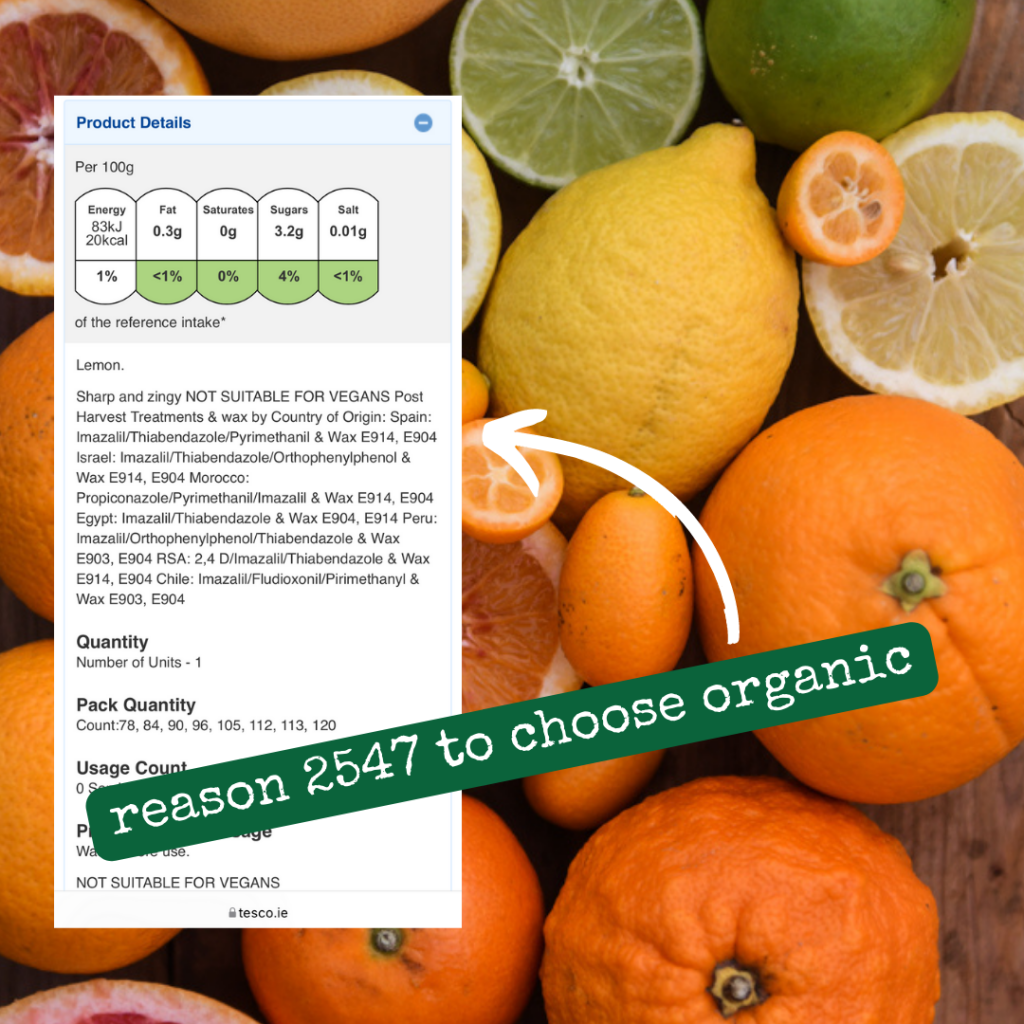
And if you were still unsure about whether non-organic produce is no different to conventional go and visit Tesco’s website and check out fresh oranges with the following details:

NOT SUITABLE FOR VEGANS Post Harvest Treatments & wax by Country of Origin: Spain: Imazalil/Thiabendazole/Pyrimethanil & Wax E914, E904 Israel: Imazalil/Thiabendazole/Orthophenylphenol & Wax E914, E904 Morocco: Propiconazole/Pyrimethanil/Imazalil & Wax E914, E904 Egypt: Imazalil/Thiabendazole & Wax E904, E914 Peru: Imazalil/Orthophenylphenol/Thiabendazole & Wax E903, E904 RSA: 2,4 D/Imazalil/Thiabendazole & Wax E914, E904 Chile: Imazalil/Fludioxonil/Pirimethanyl & Wax E903, E904

I get it though and the fact remains that it is certainly better to be eating fresh fruit and vegetables that much of the Ultra processed food that line supermarket shelves.

But if you wish to limit your exposure to pesticides in your fresh food which were found in over 50% of veg and over 60% of fruit then organic is the clear choice.

And finally in 2015 one of the most comprehensively undertaken studies showed

“……that the evidence from this study is overwhelming – that organic food is higher in antioxidants and lower in toxic metals and pesticides.

So please if you are going to make general sweeping comments such as “there is more pesticides found in organic produce, and it is no better for you” on national radio please get your facts straight.

As always thank you for your support.

Kenneth

1 teaspoon is enough to …

One teaspoon of this pesticide is enough to kill 1 billion bees. The chemical in question is thiamethoxam a member of a class of pesticides called neonicotinoids.

Back in 2018 the EU banned the use of neonicotinoids for control of pests such as aphids in crops. This family of pesticides had conclusively been shown to contribute to colony collapse disorder in Bees. With Bee populations and insect populations in free fall around the world this was a positive and bold step against the large multinational producers of these toxic chemicals.

However, these pesticides are still prevalent in nature, right here in Ireland, our soils are till contaminated with residues of this class of pesticide even though some fields were never sprayed with this chemical and considering its overall ban in 2018 this seems remarkable, researchers from Dublin city University discovered.

Having said all that the key point here is that back in 2013 you had the giant manufacturers blatantly claiming that the pesticides were safe for bees, and blaming other factors for bee population decline. Farmers, scientists and these companies were all foretelling the end of agriculture crop devastation if these chemicals were banned.

A very similar argument used today when it comes to Glyphosate interestingly. Roll on over 10 years, and with the ban we still have food, we still have crops, and it seems that the removal of these chemicals has not caused the devastation the propaganda from the multinational pesticide manufacturers would have had us all believe.

Here is the funny thing though, but it isn’t actually funny at all, the manufacture of these chemicals still progresses right here in Europe and these chemicals in dizzying amounts are exported to countries where there are no such bans. For instance:

Unearthed and Public Eye found that Syngenta notified exports of more than 10,400 tonnes of thiamethoxam-based insecticides from the EU in 2021, to 61 different countries.

Of the 10,400 tonnes more than half of that weight came from a single planned export to Brazil of 5.9 million litres of the company’s blockbuster pesticide Engeo Pleno S – enough to spray the entire surface area of New Zealand.

In the UK which in its wisdom decided to depart the EU in 2021 has been granting emergency use of this class of pesticide right up until last year on sugar beet of all crops. Thankfully it looks like the light has finally been seen and a Pesticide emergency authorisation has been denied for 2025 to protect bees.

So, it seems we can make the changes necessary to protect biodiversity when we band together and fight. There will always be a fight it seems to do the right thing, but sometimes just sometimes good prevails and the right thing is done.

We certainly will never stop fighting and never stop sourcing and producing food in the right way as we have been doing for nearly 20 years.

And As always without your support this would not be possible so thank you.

Kenneth

I was never going to be a Franciscan monk…

I must have been 13 years old when I started working as a helper gardener with the Franciscan monastery in Corrandulla, and no this was not to be my path! It was purely a means to an end for a young lad and to be fair I had an interest in working outdoors and with plants.

The monastery had glass houses and a walled garden, it was amazing and unheard of back then in the mid 80’s. There were tomato plants in those glass houses. I cannot tell you how unbelievable it was to see tomatoes growing in Galway back then. One job I remember in particular was using a knapsack sprayer for the first time. This is a sprayer that you put on your back. The head Gardener filled up the sprayer and I was given the job of spraying the tomatoes, I was told the spray was for the plants and that was it, and off I went to do my job.

The tomatoes were doing really well, so I sprayed the plants thinking I was doing some good. The day finished and I remember it was a Friday, and I went home. On my return to work on Monday I was greeted with a less than happy monk, the plants were all dying, I guess he added the wrong chemical to the mix, it was quite probable it was Roundup. Since Roundup’s introduction in 1974, weeds have out paced the ability of chemicals to control their presence. Superweeds are now well documented such as Palmer amaranth. The chemical company’s response has been to increase the application rate of the said chemical or/and merge two herbicides such as Glyphosate and Dicamba, the second of which is now banned again.

These increased toxic cocktails are not a step in the right direction.

The entomologist Robert van den Bosch coined the term “pesticide treadmill,” a concept referring to the slow escalation in the potency of the chemicals needed to control pests and maintain crop yield. The challenge of course though is in a world now reliant more and more on GMO seeds and heavy doses of one single herbicide, how do farmers in this system produce food when it fails as it is now.

There are different possibilities, but there is little doubt that the years of cheap commodity crops being raised to feed animals may be coming to an end.

The number one reason that organic food is more expensive than conventional food is the labour required to manage weeds. Spraying a field with a chemical is easy and cheap. Having said all of that the potential benefits of moving away from chemical agriculture towards a more holistic approach to food, can be financially viable. The costs associated with less sickness, increased biodiversity, less pollution, clean water, clean soil and healthier food; these hidden costs of the impact of our current approach to agriculture could then be redistributed fairly to farmers to protect our amazing planet. Like the tomatoes in the green house, it was as I know today completely possible to grow these phenomenal plants without any synthetic chemicals whatsoever.

As always thanks for your support.

Kenneth
The Dirty Dozen

Have you heard of ‘The Dirty Dozen’?

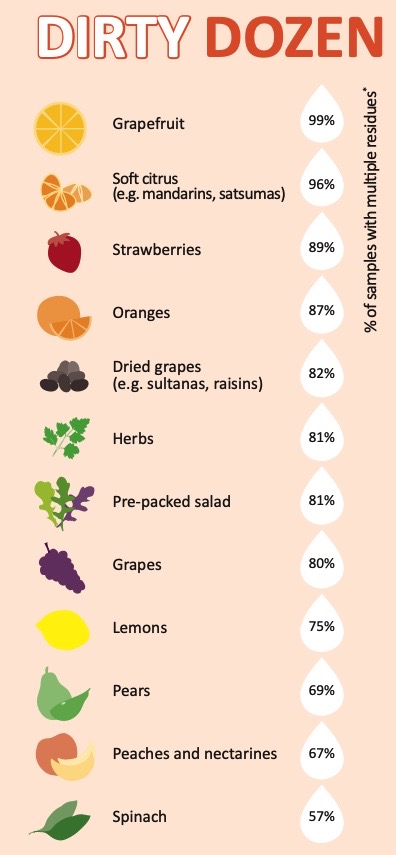
The Dirty Dozen is a list of 12 fruits and vegetables which have been found to contain the highest levels of pesticides. The aim of these lists, which are updated yearly, is to inform consumers about which fruits and vegetables to prioritise when buying organic. Of course we dream of a future where everything in our shopping carts is organic, but we know that right now, not everyone has access to organic foods. We work very hard here in Ireland to make organic food accessible to as many people as possible. Please take a look at what we can convieniently deliver to your door here.

Dirty Dozen lists are fascinating and highlight the danger of the cocktail of chemicals found in our food. Unfortunately you won’t find a list of the pesticides used on most fresh fruit and veg. However we found it very interesting looking at this label on lemons from a popular online supermarket here in Ireland. Although it is shocking to see, at least it is upfront and evident and we hope that labelling like this will soon become the norm so that consumers can make informed choices. What do you think?

For a ‘Dirty Dozen’ list most relevant to us here in Ireland we’ve been looking at PAN-UK. Pesticide Action Network (PAN) is a network of over 600 participating nongovernmental organisations, institutions and individuals in over 90 countries working to replace the use of hazardous pesticides with ecologically sound and socially just alternatives. Here’s a screenshot from their website on the latest list:

Fruits (especially citrus) and salads seem to be the biggest culprit. But it’s important to remember that these are just the top 12 fruits and vegetables containing pesticide residue, almost all non-organic foods will contain pesticides. Unfortunately washing or peeling your fruit and veg will not be totally effective in removing the pesticides. Many pesticides are systemic, meaning they are absorbed by the plant and can be found throughout, not just on the surface.

There is a growing body of evidence that pesticides can become more harmful when combined and the ‘cocktail effect’ has long-been recognised as an area of concern. Despite this, little has been done to understand or prevent the human health impacts that may occur due to long-term exposure to pesticide cocktails. Find out more about the cocktail effect.

Let us make it easy for you to avoid the cocktail of chemicals found in your supermarket trolly. Order a box from us today, we deliver to every address in Ireland and Northern Ireland and we would love you to join the Green Earth Organics family.

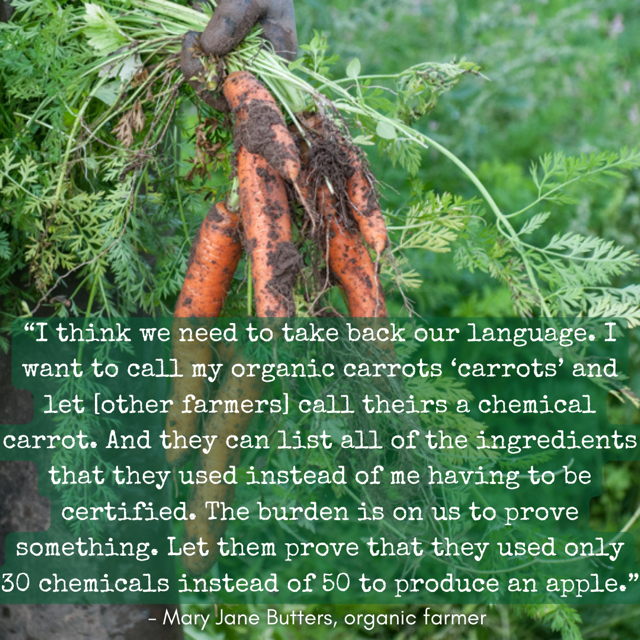
What are your thoughts on organic farming versus the over-use of pesticides on most (but not all of course) non-organic farms? Do you think pesticides are essential to produce enough food for a growing population? Or is there a better way with tried and tested organic systems? We’d love to chat in the comments. We’ll leave you with this quote we love from Mary Jane Butters.

Weed Control & Roundup

Over the last couple of months, I had forgotten how grounding growing food is. On a sunny day or sometimes even better on a wet and windy day walking through the crops, or sampling the fresh harvest, leaves you feelingconnected to the land and alive.  It is easy to forget all of this.  
 
These days it’s very difficult to know how the food we eat is actually produced. How could we be expected to know?  Life is so busy, and supermarkets give us a shiny happy reality that is often disconnected from the real food production processeshidden behind the scenes. 

The end of the growing season is a mad rush it always is and just when you think you are finished you discover you are not. We have finished planting, but the weeds have marched on relentlessly. This warm humid weather is ideal for cropgrowth but also for weed growth. 

This year our work apart from one or two mishaps has kept pace with the weeds. But our approach to weed control is notone of total dominance, quite frequently once you get the crops to a certain size the weeds are no longer a problem. 

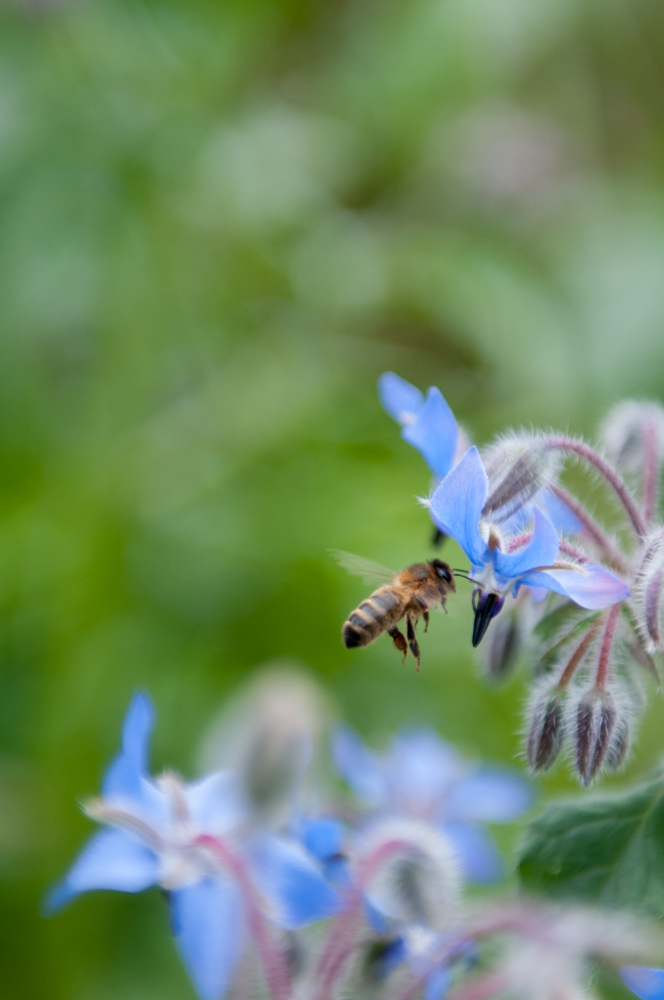
In fact, they can provide a basis for a wide variety of life: flowering weeds that bees come to, the lush green undergrowth, a haven for a myriad of tiny creatures that would not be there otherwise. 

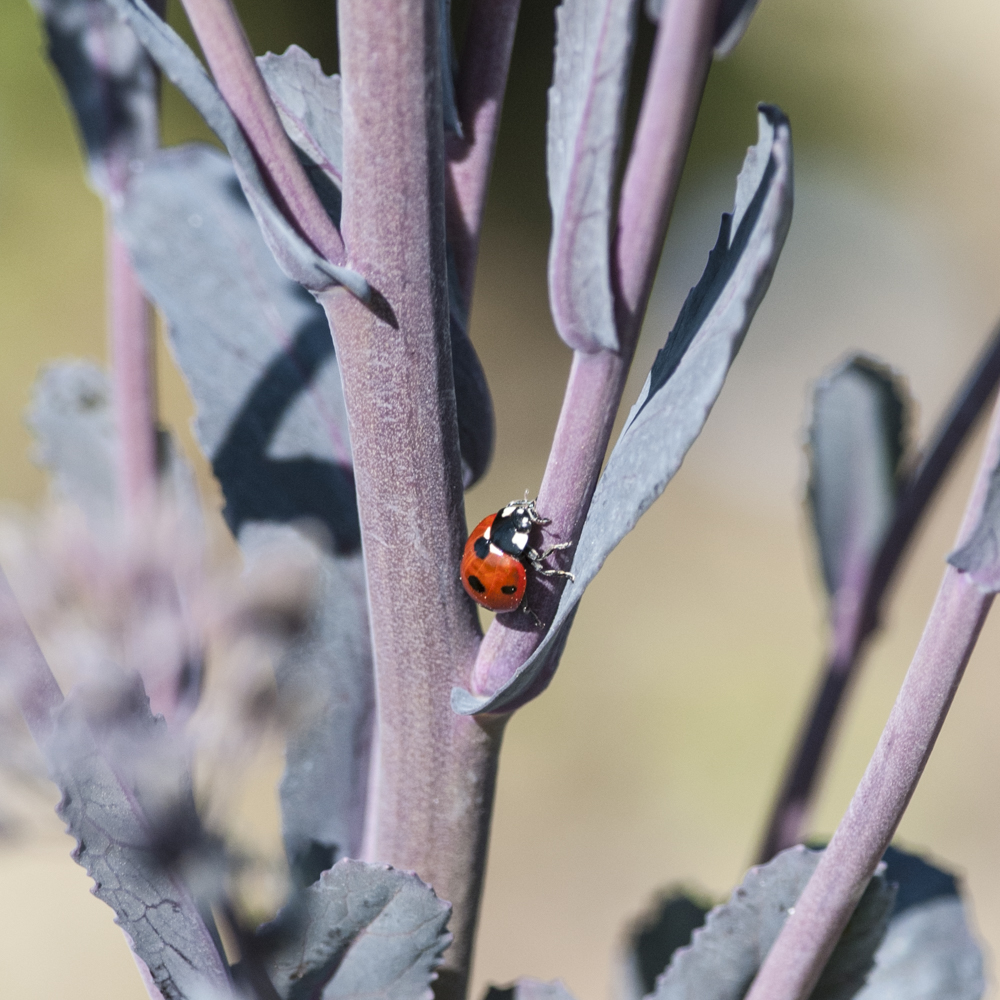
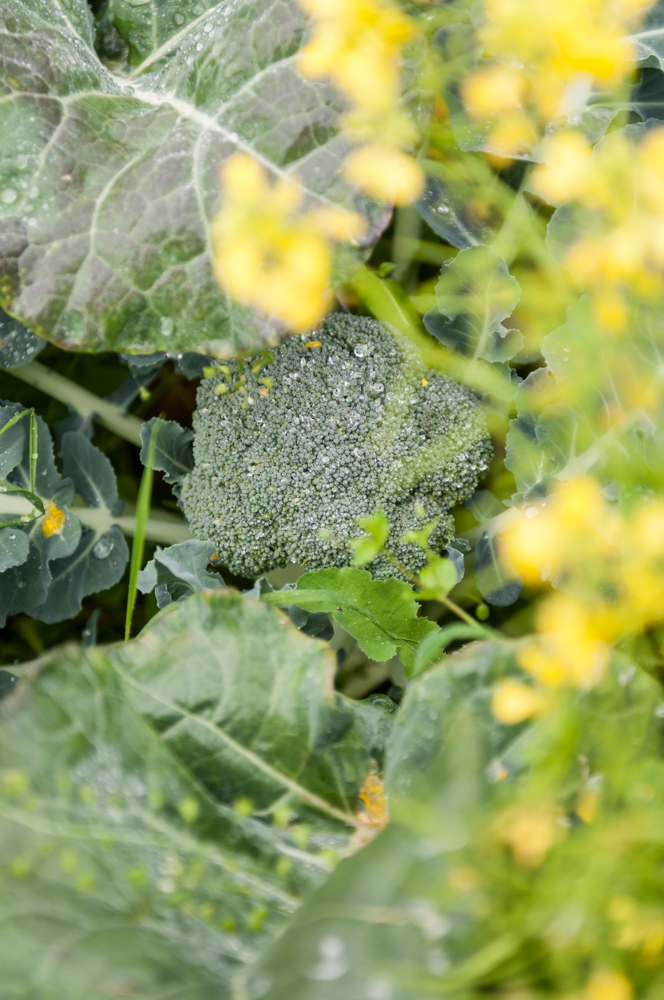
Thus, in turn providing food for the birds, and at times, the necessary predators such as ladybirds and hoverflies that feed on aphids. A natural ecosystem living below the giant shading leaves of the broccoli plants or cabbages develop. Each plant brings something different to the fray and generally none are unwelcome.

Now please do not misunderstand me, if we did not take a pragmatic approach to weed control and utilise all the tools at our disposal there would be no crops, no food, and no farm. We have worked extremely hard to ensure the crops are healthy and weed control is part of the process. No, our approach is just different, less harsh and embraces the idea that yes, we can work with these other plants, and they too have a place on our farm. 

Conversely conventional farming relies on the iron fist of chemicals to control weeds, there is no room for negotiation here, the chemicals are designed to disrupt metabolic pathways in plants, they are generally systemic in nature (get absorbed into the plant and reside there after application, all the way up the food chain onto our plates), the weeds are removed, and the residues of the chemicals remain in and on the food. Just look at the side of any road sprayed with roundup, it is ugly and yellow and dead. 
 
Using chemicals to fight nature will never work. In the short term it may give a temporary reprieve from a certain disease or pest, but that pest will come back stronger and more resistant next time. It is in a way a self-perpetuating industry.It is not the way and IT IS CERTAINLY NOT OUR WAY.

Organic agriculture is much more than saying no to the use of chemicals, it represents a holistic approach to working with nature, to our land and to our food. It means no chemicals, but it also means no artificial fertiliser, it means tree planting, it means hedge planting, it means allowing nature its place to thrive while also producing food. It means taking care of the soil and it means producing food that tastes fresh and good and crucially is good for us and for the environment.

Here’s to fresh organic food!

Kenneth

PS: It is a strange time, normality is creeping back into our lives, kids are going back to school as are ours, routines if there are ones will be re-established. It has been a strange year, some things are certainly outside of our control, but we can control what we eat. Keeping good healthy fresh food in our fridge, means we are more likely to use it, and this means we will eat healthier and feel better, as we head into autumnaldays this is one sure positive step we can take.