Isn’t it ironic, don’t you think….?

“Isn’t it ironic, don’t you think? Alanis Morissette, to add our line to this great song “We have tonnes of fresh Irish organic produce and all our customers go on holidays, isn’t it ironic don’t you think?” We asked last week if you could help, and you certainly did, we were bowled over. Can you help again next week and continue to support us during the summer when we need it most?

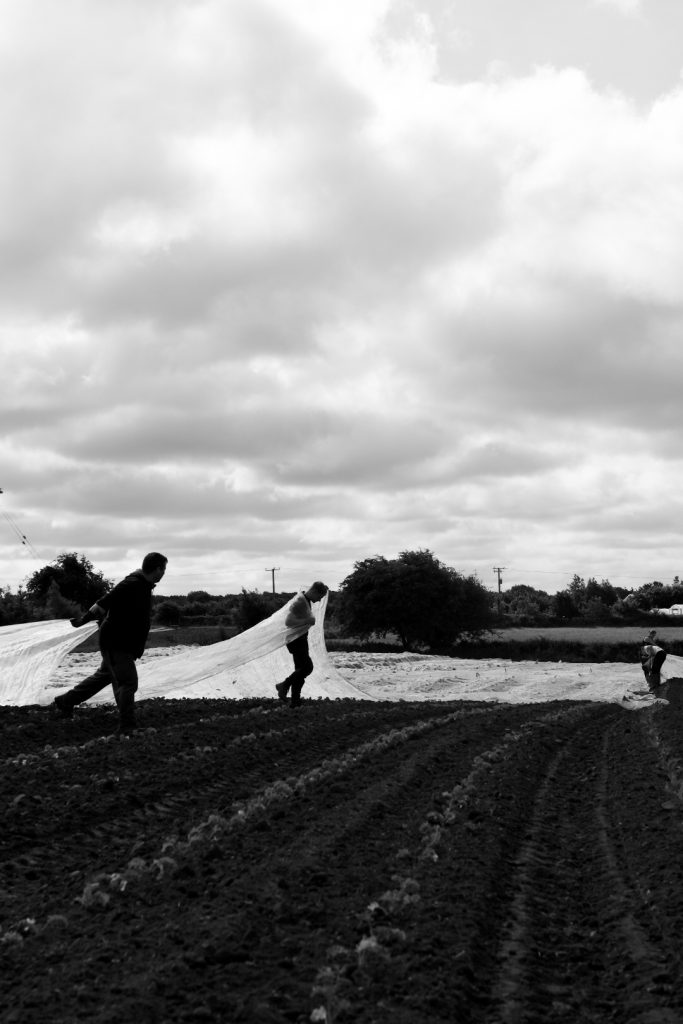
It is Thursday the 25th of July as I write this. I have spent the morning in the farmyard grappling with one frustration after another, it is a fact of farming life when you have machines you are given near daily opportunities to practice patience. Today has been a great day for that practice. Our net machine that unrolls the nets to cover the crops and conversely rolls it back in when we need to harvest decided to stop working and after visiting a couple of places it was the kind help of a neighbour that hopefully eventually has set us on the right track.

Our planting machine decided it was time to break a drive chain, and again after visiting 2 fixer type shops it was the kind help of the individual in the second shop that set us straight and fixed the chain, enabling us to get on with the final tranche of brassica plantings.

Then there is the weeding machines. Maybe, it is just that July is so insanely busy or maybe it is that these machines pick their moments and they all go caput together, is it a planned assault on a farmers sanity? Our trusty and old intrarotovator came apart in the field, again it was the timely and very kind help of a metal working neighbour that put it back together and dropped it back to us all in the space of a day.

The final machine to play truant this week was our usually very reliable brush weeder, it hasn’t exactly broke, but because the conditions for weeding have been so exceptionally poor, wet and sticky, the brushes have worn away to nothing and we need to replace them, this we are still working on.

That is just this week! But I realised if it wasn’t for the connections we have with people and other businesses in the area and their willingness to help us in our time of need and get us the fixes that we urgently required everything would have ground to a halt.

I tell you this because you are one of those people, you helped us out in our plea last week. Your amazing support and help this week just gone kept our wheels turning so to speak, we saw over 300 extra orders and that has made an enormous difference to us. All the sharing, comments, orders, good wishes, it all matters, it saved the day.

Our weeks keep going, our harvest keeps coming in, our machines keep breaking and we keep going and whilst I was messing around with all these bits of machinery the farm team were busy harvesting all sorts of fresh lovely produce from our fields.

But next week is a new week, with new challenges and opportunities, we will still be here harvesting and working away on our farm, and if you can continue to support us over the week and weeks ahead it keeps us going especially for the ironic (loads of produce, not loads of customers) months of July and August.

You can watch my weekly Instagram update by clicking here.

Thank you as always for your support
Kenneth

PS I have just eaten our very first freshly harvested cherry tomatoes, over 1 month late this year, and I am not promising there will be very many next week, but we certainly have loads of other freshly harvested Irish organic produce, to see it all click here.

This is a summer plea…

In our 18 years of growing food, the last 12 months have presented some of the biggest challenges we have ever faced. We have experienced the most difficult growing period in our history with relentless wet and dark weather.   

Our harvest this year has been delayed, and whilst last year at this stage we were harvesting nearly a quarter of a tonne of cherry tomatoes a week, this year we have plenty of fruits on the plants but no red ones, and we are now heading for a month behind schedule. There is little doubt that the changing climate is making it more and more difficult to produce good quality food consistently in the relatively short season we have.    Adding to the challenges (and this one was of our own creation) was the launch of our new website IT system that brought us to our knees nearly 3 months ago now. We have worked through most of the issues and the experience you as a customer will have now, compared to three months ago, will be much improved.

If you would like to listen to my little story this week from one of our fields CLICK HERE!

The initial start of the growing season costs on our organic farm: seeds, plants, fertiliser (organic), compost, contractors and labour are high, before you harvest even one bean. All of this is necessary to make the food in the fields happen.   All of this can generally keep going once the music doesn’t stop and there is enough money in the pot to pay for all the costs and increases in wages and all the other general business costs we face. In most years our farm spends 6 months accruing debt and the next 6 months paying that debt off through harvest. This harvest although somewhat delayed for certain crops this year begins in July, and this then, becomes our critical month for starting to make some inroads for paying bills and getting our house in order.   It should not be a surprise to us that our sales drop in July as everybody takes a much-needed break from routines and goes on holidays (but for some reason we always think this year will be different!). Unfortunately, this coincides with our farm’s and our other Irish farmers bumper harvests too.    So, we find ourselves with our harvest rolling in from the fields, with gorgeous kales, cabbage, cucumber and courgettes, salad, lettuce and the first broccoli starting next week from our own farm.  Scallions, spinach, fennel (from Enda Hoban), beetroot, and leeks from Beechlawn Organic Farm, ruby chard, parsley and spinach from Millhouse Farm, cucumbers and courgettes from Joe Kelly, the first new season Irish potatoes are arriving from John Larkin this week too and much more.   It is a double downturn for us, as our costs go up and our sales go down. Anybody will tell you this is not a good way to run a business.   So, as we head into the season, I would ask you to please if you have not restarted ordering with us again if you can at all to please do so. Or if there is any way you could tell a friend, or maybe set up a repeat subscription for the weeks you are here, or order a charity box, or bring your order with you if you are holidaying in Ireland then that would and does make a massive difference. 
It keeps us viable; Instead of buying your produce in the supermarket, can you support us instead? It keeps the very best healthiest food on your table. Our team in customer service are on hand to answer all your questions 9am – 3.30pm, 5 days per week and they are more than happy to help in any way they can.   So, this is a plea, a plea to ask you to order next week if you can, if you haven’t come back to us yet and you can now it would make a massive difference.
As always thank you for your support. Kenneth   PS  Check out our IRISH SECTION HERE

And a Garda knocked on our door…

Imagine it was less than 20 years ago when somebody erecting a polytunnel in the west of Ireland was looked upon with mild suspicion.

Or so it seemed as we were eating our dinner one night and we had a visit from the local Garda: “what are you growing out there?” “Do you mind if I take a look around?” he was of course referring to the polytunnel. I am sure the pepper and aubergine plants and even the tomatoes would have looked foreign to him, and of course they would have. Where else would you see these plants growing, certainly not in the West of Ireland, not since the supermarkets stepped in and went on a rampage of destroying our industry. Anyway, we showed him around and alleviated whatever concerns he may have had…. If you would like to listen to my little story this week from one of our fields CLICK HERE!
The second interesting occurrence, well to be fair there were many on this journey, but on this instance again it was a recommendation by a well-meaning neighbour. He could not believe, just could not get his head around, why we were not using Roundup and his advice was “just a touch of Roundup, here and there will sort you out”. Well, that was never going to happen, there is little doubt though considering we were fighting with a field covered in “scutch grass” that it would have made our lives so much easier. 
It is hard to fathom how the discovery of Roundup revolutionised farming, it found its way into every aspect of farming, from grass reseeding to tillage to horticulture and to many older farmers it must have seemed like a miracle.   All that hard work of weed control was suddenly controlled out of a can, it was easy and it was safe they were told.  It was like the iphone of weed control, it really did change everything. Or maybe a more likely analogy would be the heroin of the drug world. Because once farmers started using it, there was no going back, and whole systems were established around its use. You had to keep using. And of course, people then forgot that there were once other ways and we were not always reliant on an armoury of chemicals to mark our stamp of control on the natural world to grow our food.
Never mind the bees, or the insects, or the myriads of plants that support life, all of that was cleared away in the name of a new efficient chemical controlled system. So that is where we are today, that is our food system, and the precarious nature of this production is never really revealed. It doesn’t take much to mess up our food supply. Roundup for all its perceived benefits has bred even here in Ireland super weeds that cannot be controlled and are more rampant, they have evolved to not be susceptible to the chemical anymore. 
Anyway, I think of that Garda sometimes, and I think of all the good things, and all the positive change that has occurred and all of the support, and all of the awareness that you good people have and I feel in earnest that things have improved. Nobody looks with suspicion anymore, I think in fact more and more people understand that relationship between our food, our planet and our health. They are all interlinked. Afterall, we have only one life, one body, one planet, one shot at doing things right, and don’t we owe it to our selves to take care of it all, and if we do one thing isn’t it worth leaving the world just a little better each day by the actions we take.
Not saying it’s easy, or we get it right all the time, but that is what we try and put into action every day.
Thank you for your support.
Kenneth PS We are seeing our orders drop as the summer kicks in, if you can at all don’t forget about us, now we are getting right into the the very best Irish product of the season, we will be harvesting broccoli at the end of next week, and hopefully the first of our own tomatoes. Check out our IRISH SECTION HERE

This is still happening today, is it not time it stopped?

When we started our farm and business it was with the aim of keeping chemicals out of our food chain. Chemicals applied enmasse out in nature destroy biodiversity and hurt our health. 

Many years ago, I had the pleasure of sitting with Darina Allen and directing questions at a Dept of Agriculture official on why the residual level for glyphosate (Roundup)  in oats was much higher than that in wheat. His answer, people eat less oats! Apparently, you can have a higher concentration of this probable carcinogen in oats because people in general eat less oats than wheat. The limit “deemed safe” in wheat is 10mg/kg and in oats it is 20mg/kg, twice that of wheat.

If you would like to listen to my weekly rant in video form CLICK HERE

No herbicide in the history of our planet has been applied so heavily as glyphosate (the active ingredient in the weedkiller ‘Roundup’) it is quite literally everywhere and in everything. 

Virtually all known conventional foodstuffs containing some processed product derived from soya, wheat or corn will have had an application of glyphosate.

The people who watch out for our health set maximum residue levels (MRLs: this is the highest limit of chemical that is allowed in food). These MRLs are supposed to protect the consumer, but they can also be set based on what is required by agriculture to be an effective dose to control a pest or disease. The concentration required to kill a weed can often be much higher than that which is considered “safe” to consume (if consuming toxic chemicals can ever be deemed safe).

These limits are often arrived at *in partnership with the Agri-chemical companies* who manufacture the herbicides and pesticides!

Take the maximum residue level of glyphosate in wheat by country:·        Canada 5 mg/kg·        EU 10 mg/kg·        USA 30 mg/kg 

Apparently, it is safer to eat more glyphosate in the USA than it is in Canada ….!? As the application of glyphosate has grown exponentially the assessment of what is safe in our food has also increased and so MRLs have increased.

The increase of allowable glyphosate residues in crops is directly correlated with the introduction of genetically engineered crops that are resistant to glyphosate. 

In 1990 3.5 million kgs of glyphosate were applied in the USA, in 2014 that number was 113 million kgs. At these rates of application, the total volume of glyphosate applied in 2014 was sufficient to treat 30 % of globally cultivated land. Nearly 9 billion kg have been sprayed since 1974, this is a mind boggling number.

Glyphosate has been labelled as a “probable carcinogen” by the world health Organisation. The state of California labelled glyphosate as “Carcinogenic”.   The conventional agriculture industry, and even the EPA, often claim pesticides are safe right up until the moment they are banned because of overwhelming evidence showing they are toxic to humans.

We are all doing what we can, conventional farmers are stuck in a broken food system, we all are, but eating organic where you can is the very best chance you have of avoiding free helpings of the chemicals like glyphosate. There are some rays of hope breaking through and although the EU granted a further 10 years of use of glyphosate in the EU, the use of this toxin for drying (desiccation) crops before harvest has been prohibited and this is a very positive step.

Through your support we are supporting a system that keeps chemicals out of our food chain.

Thanks as always, here’s to clean healthy food.

Kenneth 

PS We are coming into the season of loveliness now, loads of fresh Irish produce, we are just waiting with bated breath for our own tomatoes, they are much later this year due to the cold spring, and you would be forgiven for thinking it was the middle of November at times during the week, I keep waiting for the “summer” to “start”! Anyway in the meantime you can check out our wonderful farm and farmers produce here:  See our IRISH SECTIOH HERE

National radio interview and a few thoughts…

During the week I was asked to come on the Sean Moncrieff show to talk about the supermarket practice of loss leading with fresh produce. Only 1% of farms in Ireland now grow veg, there are only 60 commercial growers left in the country down from over 400 in 1998.   

You can listen to the interview here

Not as glamorous as talking from a box in the middle of the field I think, but we gave it a go anyway!  

And if you are inclined to listen to my rant from a box in a polytunnel CLICK HERE

Here’s an example to illustrate exactly why this is happening, a few years ago most of the celery and scallions during the season were grown in Ireland, now that situation has changed dramatically. This year there has been a massive decline in Irish grown celery and scallions on supermarket shelves, and why is this? The bottom-line growers, who are struggling to cover production costs (they have gone up by 43% in the last 3 years!) could not negotiate a very small cost increase, and we are talking cents single digit here, as a result the farmers decided to stop growing the produce.

Two years ago one of the biggest sprout growers in the country closed after three generations due to lack of supermarket support.

The irony of this situation is that as supermarkets continue to practice squeezing the primary producer here in Ireland for short term gain, they must look to source the produce elsewhere.  But there is pressure on growing systems everywhere due to climate change and as a result they can end up paying more for imported produce.

Because after all, with the disastrous growing year we had last year, if you cannot put a little aside in the good years how do you survive the bad years and if your only outlet is the supermarkets, and they won’t help out then there is no other viable choice but to stop growing food.

We, who once were a nation of food producers and vegetable growers have let our primary vegetable growing industry virtually disappear.

I strongly feel that it is a very sad reflection on this retail model and the mindset and expectation it encourages in us as consumers that fresh produce is worthless. Not only does it make the craft of growing food financially unviable, but it is highly demoralising to growers to be told that their produce is essentially worthless.

At the very same time that fresh produce is used to get consumers in supermarket doors by devaluing it to nothing, you have a production and retail industry that thrive on making high margins on junk food. This food, ultra-processed rubbish, is nutritionally worthless and is making us sick and lines most retailers’ shelves.

The solution is simple, primary producers need to be paid more for the produce they grow, this can come about through the celebration of fresh produce, food that will make us well and healthy and in the long run ironically will save us all money and will save an industry.

As always thanks for your support.

Kenneth

PS We have amazing Irish organic produce now, from our own farm, kale Green, Black (Cavolo Nero), Purple, salad, lettuce and courgettes, we have Irish produce from Joe Kelly in Mayo, Padraigh Fahy in Beechlawn, Marc Michel in Wicklow, Enda Hoban in Galway, Mick and Audrey in Millhouse, John Mc Ardle for mushrooms, and so much more.  See our IRISH SECTIOH HERE

Happy Summer solstice! It is amazing to see the length in the evenings.

I’ve just come back in from the fields, it is Thursday night and I had been attempting to sow our second crop of swede. It is very late in the season for this and as it turns out something went wrong with the seeding unit and I will have to take a closer look at it later, and I am not at all certain even this second sowing was successful.

The reason I was resowing swede was due to a tiny little black insect called a flea beetle. These little creatures’ prey on tender brassica leaves and as the first little swede leaves unfurled, they decimated them. To an extent it is our own fault as we should have covered the beds with netting as soon as we did the first sowing, but I didn’t. It was one little job that got away from us.

Anyway, as I was driving back to the farm shed in the tractor, I was thinking about the fundamental difference between organic and conventional. In the world of conventional production, a farmer can spray his crops with pesticides, these chemicals are not specific to one particular creature and can have devastating effects on biodiversity. The reality of conventional vegetable production is the routine use of herbicides, such as glyphosate, pesticides and fungicides. As organic growers we us no chemicals, and on our farm, I can categorically say we use zero chemicals.

But the burden of responsibility to prove our organic credentials rests with us, it is up to us to pass in our case two annual inspections and to show the paper trail to demonstrate that we are adhering to the rules. There is no question though, organic certification is a good thing, and it clearly shows to you, that producers are indeed growing food safely and chemically free amongst many other things. You should always look or ask to see if food is certified organic.

But back in my grandad’s day all his produce was “organic” he didn’t have to fill out any forms or prove that he was not using chemicals; to be fair this was a time before farmers were routinely using chemicals in food production. But today that has all changed and now there is a massive industry that makes vast profits from selling chemicals that are used in our food that are toxic to us and are destroying biodiversity. Chemicals do not belong in our food system; I should know I spent my life studying and working with them.

How different the supermarket landscape would look, if instead of looking for “certified organic” all produce that had been sprayed had to have a label outlining the chemical treatments it received on its journey from seed to supermarket. How different then would our food system be? Imagine your carrot bag labelled with the following which were the top 10 applied chemicals on carrots grown in Ireland in 2015, the last year where there is data available.

Lambda-cyhalothrin, Linuron , Metribuzin, Azoxystrobin , Difenoconazole, Pendimethalin, Prothioconazole, Boscalid, Pyraclostrobin, Tebuconazole

Or you may remember that our kale was taken to be checked last Nov, and they checked for 870 chemicals. That is 870 chemicals that they thought could possibly be on our kale and as result are or could be used in conventional agriculture! The mind boggles.

For me and our business and farm, the journey for the last 18 years has always been about producing and supporting other organic growers who are doing their very best to grow healthy food whilst protecting biodiversity and never ever using chemicals.

As always thanks for your support.

Kenneth

PS Back by popular demand is the “Fresh Irish category” where you can see straight away all the local organic produce we have.

A story told sitting on a box in the middle of a field…………

I found myself the other day sitting in one of our fields on a box, as you do, contemplating what to say in this weekly update.

To watch this post from a box in a field click here: https://www.instagram.com/reel/C8L39NDs9qi/?igsh=MmZxZ3lkdHAyejRn!

A couple of days earlier I had been attaching a slightly modified version of my grandad’s old stone roller to our tractor. He used this roller 2 generations ago to roll the land, pulled behind two fine workhorses he used to own, one of which I remember was called Snowball, because he had a white snout that looked like a “snowball”! I was rolling the land because we had just sown two and a half acres of wild-flowers, a mix of organic clover varieties, phacelia and flowers for the bees and for our soil. All that seed was certified organic which means even in raising the plants to produce the seed the land was treated organically.

So, As I was sitting there on my box, I was thinking about all your support over the last couple of weeks and I just wanted to say a huge ‘thank you’. I also thought that maybe it might be nice to explain the impact or the reality of what that support actually means. So that 2.5 acres of wildflowers, which are doing so much for local biodiversity would not have been sown without your orders. Just behind the box I was sitting on, I had just sown a bed of wildflowers to allow a proper bee corridor to run the length of our farm.

Emmanuel and his team were out the other day, and they planted several thousand brassica and celeriac plants, all of this was done without the use of artificial fertilisers, which are highly water soluble and when it rains they end up in our waterways and lakes, leading to eutrophication and pollution. Of course, everything here is planted without the use of herbicides and pesticides, these chemicals cause cumulative damage to our biodiversity and our health. Your support means these chemicals do not touch our soil and do not interfere with all the biodiversity on our land.

The trees that we have planted over the years, and there are thousands of them would not have been planted, the hedgerows that house a myriad of life would not be thriving, the two pigs Florence and George would not have been rescued, without your support. The 8 polytunnels would not have been constructed, the 700-800 tomato plants would not have been sown, fresh Irish organic tomatoes (if we ever get any proper heat this year) are only 5-6 weeks away, none of these things would have happened without your support.

All of these things are happening because you are buying from us and placing an order each week. Whilst you are supporting a new system of food production, you are also getting the best, freshest and chemical free produce in Ireland.

Your patience with our new IT system is so much appreciated and I can only again apologise if your experience has been less than positive. We are nearly there on this journey, and we hope in the next couple of weeks to have ironed out many of the issues and glitches and we hope then we can finally look to really introduce you to all the amazing features this new website provides. This is our portal to connect our produce and the produce of other Irish organic growers and so many amazing sustainable groceries direct to you, our customers.

As always thank you so much for your support and now I feel it is time to pack up my box, my seeds and go home.

Kenneth.

PS We have amazing Irish organic produce now, just use the little filter on each page to see what is Irish.

Thank you so much and an inconvenient truth……….

Thank you so much to everybody who ordered from us last week, we were blown away by the level of support, it made a massive difference. When you buy with us, we notice, supermarkets don’t, but we do. So, thank you so much from everybody here.

We had three little remarkable surprises this week (not counting all your amazing orders), we received Irish organic cherries (Can you believe that!) from Darragh Donnelly in Dublin. Emmanuel our farm manager found a small robin’s nest in our farm shed and finally after 18 years of picking stones we found a solution to our stone problem! The cherries are amazing, and I guarantee that you will not find their like in any supermarket shelf, so thank you Darragh.

As to the robin, he or she, I certainly can’t tell, (can you tell?) chose a very inconvenient location to build (I will go with a she) her nest: right in the middle of where we are coming and going all the time. But we are going to be careful and the three little eggs that are in the nest will not be disturbed.

The stones have been, and I have to go a little further here than calling them an inconvenience, they have been a devastation for so, so long. But completely by chance this week I got the number of a contractor that has a stone crushing machine for farms, yes there is such a thing, and it is quite remarkable. So, in the space of 12 hours, this very nice fella and his tractor crushed all our stones, releasing vital nutrients back into the soil.

Afterwards we tried making some vegetable beds, this usually can be quite a fraught process, shaking the machine, destroying tines, and frequently lifting the whole machine out of the ground when you hit a big stone leaving the bed in less than an ideal shape. But the bed forming in our “new, stoneless” farm was quiet and smooth, and just nothing short of amazing.

Watch a little video from our fields here.

So, stones and robins making nests in odd places, two inconveniences, can we live with them? The robin yes, but the stones, they just had to go! This is the issue with our approach to agriculture these days, we aim to eliminate anything that is inconvenient, and there is a long list of these inconveniences. Weeds, eliminate them with a quick spray of roundup, aphids reach for the next can of spray and so on and so forth, it doesn’t stop; hedgerows, take them out if they are taking up valuable space, trees cut them down make way for production. What is this madness? The shortsightedness, the relentless focus on extracting the last cent from the land to the detriment of all the other aspects of our living world that we need. WE NEED BIODIVERSITY it is not and optional extra!

Maybe there is no other way, while the cost of produce continues to be so devalued, maybe that is the true price that must be paid. The price you or I pay at the till for the plastic clad supermarket produce absolutely does not reflect these sacrifices the natural world makes for our convenience.

So, the question is: can we afford these inconvenient truths? Is it worth it to get the very cheapest price possible? Well, I will leave you to decide, and judging by your support for us last week and hopefully in the week and weeks ahead again you have already made your decision.

As always thank you for your support

Kenneth

this is a plea, but not our usual one…

Growing food at the best of times is not a money-making enterprise, far from it, we only ever expect the farm to break even and most years this is a stretch to achieve. In fact nearly every year of the last 5 years, our retail business has made up for the losses we have incurred on our farm.

You can see the little video from our tomato polytunnel where I talk about the challenges of the last five weeks, click here to watch.

We grow the food, because we love to do it, because sustainable agriculture is something we strongly believe in, and we believe is the key to a healthier future.

We have PV cells generating our electricity, we have invested in a zero-emission electric van, we collect our rainwater, we plant trees, and hedgerows, we use only plastic free packaging. We educate people on how important biodiversity and sustainable growing is through social media, blog posts and farm walks. To get everybody involved in thinking about the planet and the environment, where our food comes and how it is produced is our critical philosophy.

All of this takes time and energy, it all costs money and at the end of the day although everybody wants to enjoy their job and although nearly everybody that works with us believes in our values and our mission, they still need to get paid.

The last two weeks I have been very focused on farm field work which has been a nice distraction from the other challenges in our business at the moment. At least to some extent you can grapple with machines and plants and mostly you know where you stand. But there is no doubt this is the worst commercial growing period we have experienced in our 18 years. This is now heading into 2 growing seasons of devastation from relentless climate related damage, nonstop rain for nearly 12 months give or take.

All that aside it has been a pleasant respite from business related woes, woes to an extent that we have brought upon ourselves. At this point if I had known the real cost and the damage a system change would have done, I would have thought long and hard about whether it was the right thing to do. I guess any major change from website to business administration will be complex and take its toll, change is hard, but as we head into week 5 post new website launch, we are staring at 5 straight weeks of lost customers. At this stage we have fixed a good portion of the problems with our website, and we continue to work on others. Things are certainly much better than they were 5 weeks ago, but we are still missing a good portion of you our customers. We know that when a habit is broken it is hard to reinstate it.

But as we head into the season when we have commitments to honour to our farm to other Irish farmers, to our own team of people here and many more, I would ask you to please if you have not restarted ordering with us again to please do so. It makes such a difference, it keeps us viable, it keeps the very best healthiest food on your table, and without you we would be no more, so if you can at all please take the time and revisit our site. Our team in customer service are on hand to answer all your questions 9 am-3.30 pm, 5 days per week and they are more than happy to help in any way they can.

So, this is a plea, a plea to ask you to order next week, to find a way (if you can at all) to continue to support us, and as we start to see the level of Irish produce increase this is more important than ever.

Thank you,

Kenneth

PS Please click here to login and place an order.

It just won’t work or will it? ……

This week there has been plenty of room at times for few choice expletives and having a bit of a tantrum, especially when it comes to machines. Each year when certain machines leave our farm shed they illicit a sense of foreboding. They put whatever patience we may have remaining, in this business of growing vegetables, to the test.

This was to be the case this week, we have three or four machines that “should” work but often “decide not to comply” with our ideas of what they should do. This week the machine that lays our compostable biolayer took us to the brink of giving up, but right at our breaking point we managed to bend it’s will to our way of doing things!

There is also our planter, it is temperamental, old and cranky and every year there is a requirement to find mutual common ground between farmer and machine, this year that ground has been hard to find and has led to moments of promising our faithful machine that its days are truly numbered. (Of course, we didn’t really mean it, all was said in the heat of the moment!)Nevertheless, if farming has thought us anything and it teaches a lot, is that perseverance is an absolute requirement to succeed no matter what happens. In the end we know we will produce beautiful healthy sustainable food.

But there are some who say organic farming will not feed the world, that it is an idealistic pursuit and just won’t work.I imagine that the same people who say these things are busy buying up the world’s seed bank and patenting the seeds they genetically modify. The same people who make quite a lot of money from selling an idea of how our food system should be and on the back of that selling the chemicals and making quite a lot of money, and in the end gaining control of our food system.

Once a diversified market, Corteva, BASF, Syngenta, and Bayer four enormous corporations now dominate the seeds sector. These industry giants have seized power quickly and currently hold more than half of the seed market. Furthermore, they control almost 67% of the world market for agrochemicals.Did you know four firms or fewer control at least 50% of the market for 79% of the groceries. For almost a third of shopping items, the top firms controlled at least 75% of the market share.Couple that with the fact that four corporations’ control 75% of the worlds global grain supply, and we see that the future of our food, our health and our planet lie in the hands of a few.

We think our food system should not be controlled by the few, and in our own little way we have been doing what we can to make that happen. We have been very busy planting and sowing and supporting other Irish organic farmers that are doing the same. For the last number of weeks we have been planting kale, cabbage, Romanesco, broccoli, lettuce, and celery. We have been sowing, salad, beetroot, spinach, chard, carrots, and parsnips, not to mention the nearly 1000 tomato plants that are finally starting to make some headway.

There is no way to rush nature, we need to have patience and get our timings right, take good care of our crops and the nature around as the crops grow, and the harvest will come.

So, we work, we wait, and we harvest, and we know that sustainable food is our future.As always thank you for your support.

Kenneth

PS Thank you to everybody who took the time to login and place an order last week. Every week with our new system, we are improving and again this week we will have offers and as usual the very best of Irish organic produce anywhere, so please if you haven’t yet do login and place an order. We think you will be pleasantly surprised. Keep an eye on your inbox over the weekend for extra special offers! Thank you so much without you we would not be here.