A crumble is by far one of the easiest desserts to make, and this recipe is incredibly versatile too, as any fruit of choice can be used as the base. I’m using a wholemeal fine ground flour, but plain flour can be used in its place. While I’m also adding oats to the topping, but finely chopped nuts can be easily substituted. I find a crumble is best enjoyed warm from the oven, with a good serving of hot custard, but ice-cream or softly whipped cream also make for delicious accompaniments.
To prepare the crumble, place the flour in a bowl. Add the butter and rub it into the mixture, followed by the oats, almonds, and sugar. Rub the mixture together until it resembles fine breadcrumbs.
Place the apple pieces in a large ovenproof dish. Add the orange zest and juice, sugar, and cinnamon. Stir to combine.
Sprinkle over the crumble mixture and place the dish on a baking tray. Bake in the pre-heated oven for about 30 minutes, until the crumble topping is golden brown. Take from the oven, cover with some foil and bake for another 10 minutes. Serve with ice cream, softly whipped cream or custard.
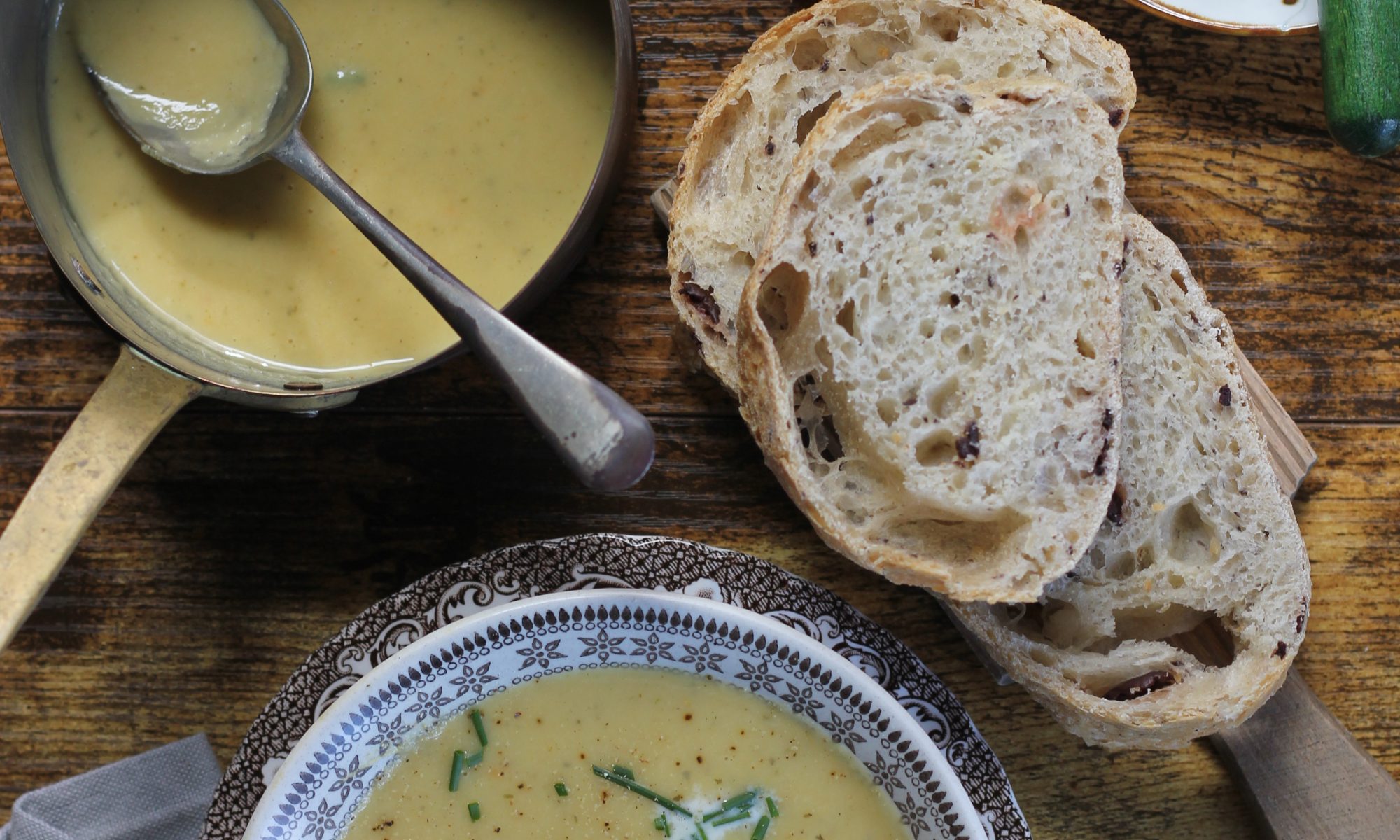
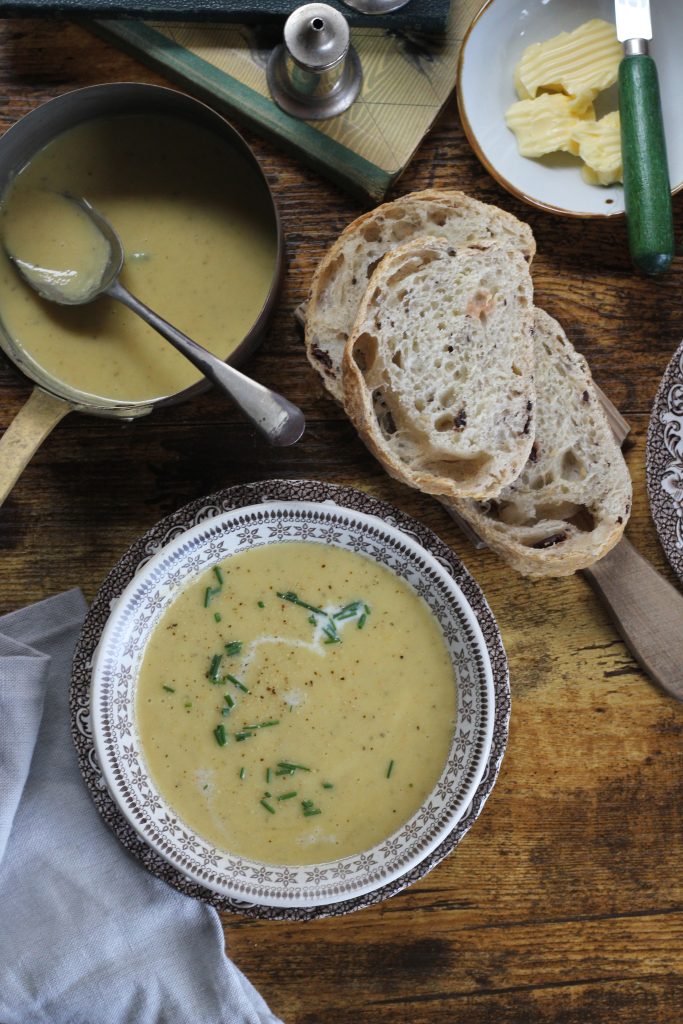
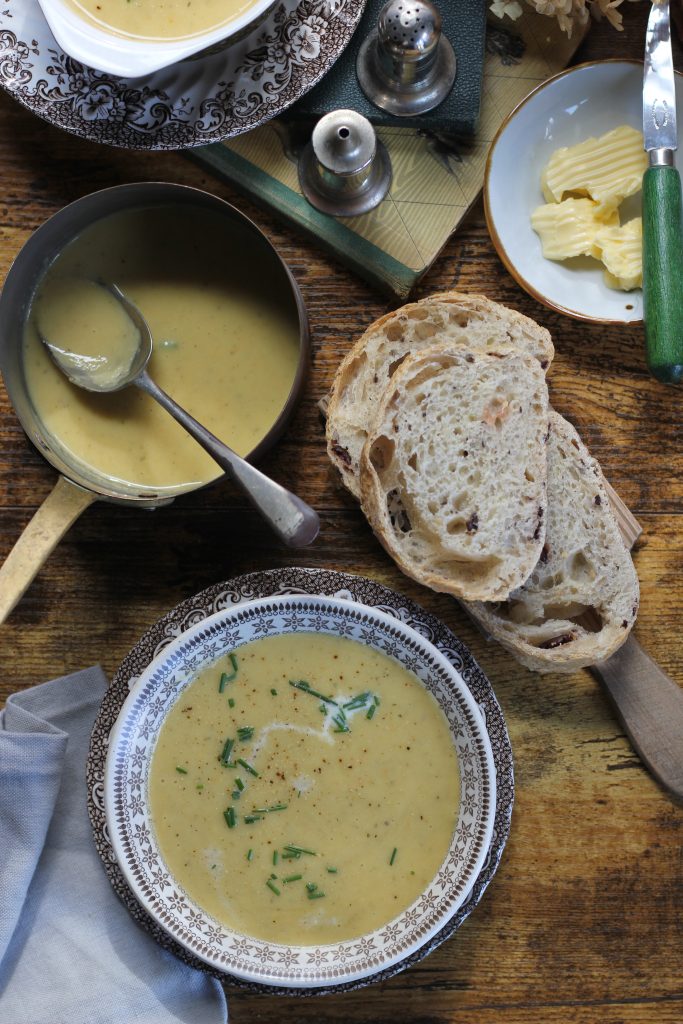
With the weather turning colder and the evenings drawing in, there’s nothing more comforting than a bowl of hot, homemade soup. I’m using freshly harvested parsnips from the farm which are sweet, earthy, and at their peak right now. Both parsnips and apples are in season here in Ireland, making this the perfect time to bring them together in a warming, autumnal dish. The gentle heat of curry spices pairs perfectly with the natural sweetness of the parsnips and apples, creating a soup that’s both nourishing and full of flavour.
Melt the butter in a large saucepan over a low heat. When it begins to foam add the parsnip, onion, apple, and garlic. Season with a little salt and a few grinds of pepper. Stir to combine with the butter.
Place a butter wrapper or a piece of greaseproof paper over the vegetables, to help them sweat. Cover with the lid of the saucepan. Sweat over a low heat for about 10 minutes, making sure the vegetables don’t stick to the bottom of the saucepan.
When the vegetables are soft but not coloured, stir through the curry powder, and add the stock. Turn up the heat a little and continue to cook for another 15 minutes or until the vegetables are soft.
Add the cream and using a hand blender or a food processor purée the soup until it is smooth. Taste and season, if necessary.
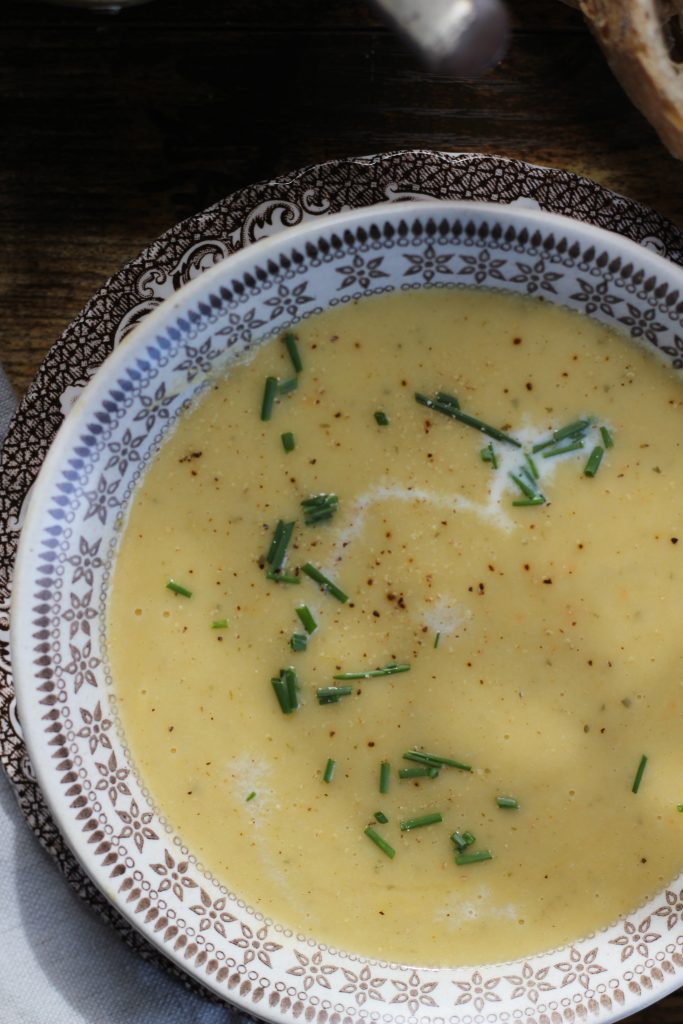
Pour the soup into serving bowls and garnish with a little drizzle of cream and some finely chopped chives.
When new potatoes are in season, it’s time to let their natural sweetness and creamy texture shine. These Garlic & Herb Smashed Potatoes are golden, crispy, and full of flavour; finished with fragrant herbs and a sprinkle of cheese for that extra indulgence.
By choosing local, in-season produce, you’re not just tasting the best of summer, you’re supporting Irish farmers and making a more sustainable choice. Simple, delicious, and made to share, this is comfort food at its best.
Preheat the oven to 220°C/ fan 200°C / gas mark 7.
Remove the potatoes from the steamer and add to a colander. Allow to cool and dry for a few minutes.
Melt the butter in a saucepan with the garlic, thyme and chives. Once it starts to bubble remove from the heat and add a little salt and black pepper.
Place the potatoes in a large bowl, add the melted butter mixture and coat the potatoes evenly.
Tip the potatoes onto a parchment paper-lined baking tray. Smash them with a flat surface, such as the base of a glass. Drizzle over any remaining butter from the bowl. Place in the preheated oven for 25 minutes. Remove, grate over an even layer of cheese and return to the oven for another 5 minutes.
By all accounts we should be delighted, and to an extent I know that delight is there, I just can’t seem to access it right at the moment of writing this (we all know the blue sky is always there but mostly at least in this country we can’t see it!), as all those newly discovered problems seem to be overshadowing the good stuff and there actually is plenty of good stuff.
But before that the challenges. So let me start by saying I consistently make the mistake of reading comments by different people that organic farmers use chemicals, I think if I hear that “misinformation” again I will go out of my mind.
Of course we use chemicals. We use soil and water and air, all of which are made up of atoms and molecules that constitute chemicals, and there are natural elements in the soil, my Ph.D. in chemistry seems to be coming in useful at last. I think the insinuation is though we also use synthetic pesticides and insecticides and fungicides.
So how can I be any clearer, we don’t use synthetic man-made toxic chemicals, we simply don’t. Copper Sulphate may be used at times as a preventative for potato blight, but even if this was used, it is not systemic it is not absorbed into the plant, it is not on the potato.
Whereas Roundup is systemic, it gets absorbed into the plants when it is sprayed on them, like it is on cereals in certain countries, it stays in them, and it is toxic. Brand new research has shown that even at levels previously deemed safe it has been shown to cause cancer in animals. (link here https://ehjournal.biomedcentral.com/articles/10.1186/s12940-025-01187-2)
Then there have been the practical challenges, with system malfunctions, and breakdowns of cold-rooms, and poor plants that we can’t transplant, and having fewer orders due to holidays and loads of harvest and not being able to sell it to support the farm, and general this and that issues. When all these challenges come all together, they can on some days be too much.
On the other hand, we have in fact got amazing crops this year, the best cucumbers I have ever seen on our farm, and so much more besides. So much so that we are giving away 500 free portions of something next week, a surprise to 500 people chosen at random, so keep an eye out it will say “free from our farm”.
We get to work on the land doing something that is truly worthwhile, producing and selling good quality healthy organic food that is improving our planet and hopefully helping humankind be just a little bit better. We cannot do that without you, your support keeps us in business, keeps the tractors rolling and the bees buzzing, so as always, a heartfelt thank you.
I hope this pouring forth of my woes for the week was not too much.
As always thank you for your ongoing help and support.
Kenneth
PS Every week you order with us over the summer makes a big difference as many people are taking a well-deserved holiday and this makes keeping all the plates spinning that bit harder here.
Most farmers whether they be conventional or organic do what they do out of love for the land, because it requires a vocation to continue on the land, we as farmers simply must have a strong desire to produce food, because without it we would quit.
The rules governing food production are tough, prices and specifications and contracts are set by contract supermarket buyers. The supermarket supply chain is mesmerising and staggering and fast, and we can be thankful in one sense for the illusion of a never ending food supply (emphasis on illusion here), but it doesn’t tie in well with the rhythm of nature. The weather is unpredictable and with climate breakdown there is no doubt it is getting more erratic and difficult to plan for. Intensification has taken over, from vegetable production to dairy production it is the first step in our disconnection from the land. If even the farmer is being disconnected from the food, they produce what chance do we as consumers have?
Yet there couldn’t be a more important time for food production and supply to be done ethically and with transparency, without the green washing and false misleading narrative of large multinational retailers, that they in some way care for you and I and the environment, they don’t. But here is the kernel of hope, they change, and they can change rapidly, because of consumer sentiment, this is an amazing thing, and it is your doing, do not underestimate the power you have,. and be reassured change is everywhere.
Yesterday I had an invigorating discussion with a man who is responsible for creating a product right here in Ireland that is helping both us organic horticulture farmers control weeds and conventional farmers use less chemicals. Matt Shine runs Samco, and he with his brother and dad, have developed a compostable biofilm manufactured from corn or potato starch that fully biodegrades in the soil.
This material is not petroleum based, it is not plastic, it is plant based. It means our 500 courgette plants can thrive in the Irish west of Ireland climate where they need all the help they can get. Right now, the first courgettes are nearly ready for harvest, the biofilm coupled with the best spring I can remember on record has helped this but we already have amazing yellow courgettes from Joe Kelly in Mayo.
And that brings me to another story, I had a long conversation with Joe during the week, and he is a grower that has been supplying us for many years, he is an individual with a passion for what he does and is driven by energy and positivity and love for a better food system, he is a true believer in the ethical production of organic food. He is a vocational small scale organic farmer, and he walks the walk, there is no green washing here.
And finally, I also had a chat with Hannah Quinn-Mulligan of Tory Hill house Farm, who is doing something truly revolutionary, bucking the trend and going against the usual dairy intensification, she loves her cows and you can see that, and is producing with the help of her mum and sister organic raw milk, yogurt and kefir.
The thing that struck me about all three people I had a pleasure of talking to this week, is that even though business is hard, and farming is hard, and even though there is all the challenges and the hard conversations, and hard decisions and work hidden from view, they love what they do and they are driven by the desire to make this world a better place though their work.
And you know what they are making a difference, and they are succeeding, and I for now am grateful through your support to have the opportunity to support them.
Thank you.
Kenneth
PS As many of you go off on holidays, we see our orders drop off. It makes it difficult to know how to manage, so if you can at all please support us next week and the weeks ahead. For those of you who received your free amazing lettuce this week I hope you enjoyed it.
My feeling when it comes to pesticide residues in our food is that the only safe limit is a zero limit. If I were to tell you that 50% of the food you eat contains pesticide residues, how would you feel?
My Grandad farmed on this piece of land that we now farm organically. He had a mixed family farm and grew much of his own food as did many in the locality back then. This food was more nutritious, it tasted better, it was fresher than food today, it was free from chemicals, and it was local and seasonal.
Today our food system is a complex web of producers, processors and logistics. When we walk into a supermarket, we don’t have time to think too much about where our food comes from our how it was produced, the shiny plastic packs of produce give us the impression that our food system is limitless, vibrant and fair. Indeed, this very supermarket system and the global food corporations that supply it have disconnected us from our food and have been complicit in devaluing our most valuable commodity: food.
Since my grandad’s time in the early 1950’s agriculture and food have changed unrecognisably. It has undergone a green revolution. Ironically this “green revolution” has left our current food system broken. GMOs, giant monocultures, pesticides, herbicides, artificial fertilisers and factory farms dominate our global food supply system, all hidden behind those shiny plastic packs on the supermarket shelves.
The term “green revolution” was always something that struck me as a bit odd, especially when you consider what green means today, this was a revolution that switched our agricultural system from a natural approach to a chemistry centred approach.
I am an organic farmer, but I wasn’t always. In fact, and again ironically, I was an organic chemist, I have a Ph. D in chemistry from Cambridge University. I spent nearly 15 years working with chemicals, pharmaceuticals and in the biotech industry, so I know a thing or two about chemicals.
Today chemicals are used to force nature to behave in the way they want, they have tried to impose factory type controls onto the natural environment that we rely on for our food. But nature is not a factory, and the same rules do not apply, you cannot indiscriminately apply chemicals to our food and not expect a fall out.
A report by the European Food Safety Authority (EFSA) has found that nearly half the food they tested from almost 81,000 food samples had pesticides in them. Strawberries and lettuce are the most likely to exceed safe limits, the agency found. They are especially sensitive to fungus and bugs and so undergo considerable spraying with pesticides.
More than one in four (27.3%) of the food samples contained traces of more than one pesticide.
The food we put into our bodies is one of the most valuable investments we can ever make. The simple fact is you can taste value, and if you have ever tasted a freshly harvested tomato, warm from the vine, free from chemicals, full of life and nutrition, then you will know what I am talking about here, that is real value. I think my grandad instinctively knew that, but then again that was all there was back then.
Here is to the best value food in the world.
As always thank you for your support.
Kenneth
Link to report below.
A new report by the European Food Safety Authority (EFSA) has found that more than 97% of foods contain pesticide residue levels that fall within legal limits. Strawberries are the most likely to exceed safe limits, the agency found.
About 55% of the samples evaluated by EFSA were free of detectable traces of these chemicals, the agency said.
This means nearly half of food products in Europe contain residues of pesticides.
The highest rate of exceeding safety limits was for strawberries (2.5% of the sample), followed by lettuce (2.3%). They are especially sensitive to fungus and bugs and so undergo considerable spraying with pesticides.
There are several dishes which can be created or elevated with leftover mashed potato; from a salad to a comforting pie-topper, there are so many possibilities for this humble staple. If you’re faced with a bowlful of leftover mash, I would however highly recommend you transform it into these delicious chive and cheese potato bites. They only take minutes to prepare and can be served as a dinner accompaniment or simply enjoyed as a snack. Any hard cheese of choice can be used, dairy or plant-based, but ensure it’s very finely grated, allowing it to incorporate well with the potato. Chives are back in season, and I love to add them wherever a little onion scent is required in a dish, but finely sliced scallions can also be used in their place. I like to mirror the flavours in the bites with a garlic and chive dip, but any dip of choice can be enjoyed alongside these crispy bites.
Add the mashed potato to a large bowl with the flour, finely grated cheese and chopped chives. Stir well to combine. Take a spoonful of the mixture and roll it into a ball. Continue until all the mixture has been used, making about 20 potato bites. Place on a plate and into the fridge to set for a couple of hours.
When ready to cook, place a large frying pan over a medium heat. Add a thin layer of cooking oil, sunflower or olive, and once hot, fry the potato bites for about 5 minutes on each side, turning occasionally while frying.
Transfer to a paper lined plate, then to a serving plate. Sprinkle with a little sea salt, a grating of hard cheese and some finely chopped chives. Enjoy immediately.
The next time you drive down the motorway, check your windscreen, it will be devoid of insect splatter, only 20-30 short years ago that used to be a completely different story. Here is something different to think about when we think about the disappearing insects, of course the insecticides are destroying whole ecosystems, but what about herbicides?
The dandelions are up in force. But consider this, next time you see a field of grass that is generally being grown to be fed to dairy cows, see how many dandelions you see, or in fact see how much of anything other than grass you see. I think you will find that there is very little. Grassland is produced to be a giant monoculture, and it is considered best practice to remove all diversity from these fields, to feed Ireland’s massive dairy industry.
But it didn’t always used to be like this, dairy cows in a not-too-distant past fed on mixed pasture. The irony of course is that a diverse array of plants access different levels of the soil and so bring up different nutrients and give a more balanced diet to the animals, providing a virtual plant salad bar for animals and supported a whole ecosystem, one a ryegrass-dominated monoculture never will.
The diversity today is removed by spraying herbicides, a typical spraying regime for grassland will involve an array of different chemicals. One that is actively used right here in Ireland goes by the tradename “Thurst” and it contains: 2,4-D + Dicamba. You may have heard of herbicides like 2,4-D before, it is one of the most common chemical weedkillers used in conventional farming. It’s designed to kill broadleaf weeds like dandelions without harming the grass. While it works effectively, it comes with a history and environmental impact that we’re not comfortable with.
👉 Did you know? 2,4-D was one of the ingredients in Agent Orange, the defoliant used in the Vietnam War. While modern formulations don’t contain the toxic contaminants that caused so much harm back then, 2,4-D is still a synthetic chemical. It can linger in soil and waterways, and it’s been classified as “possibly carcinogenic to humans” by the World Health Organization.
This is just one of a handful of chemicals that are used to keep grasslands, green, full of grass, and absent of biodiversity. Giant monocultures whether they be GM soya crops grown in the US or giant fields of grass grown in Ireland are food deserts for insects, there is nothing for them there, no weeds, no flowers, no food. The chemicals themselves that act on the plants are removing a crucial piece of our ecosystem that has a knock-on effect all the way up the food chain. We hear a lot about bees, and bee populations have been devastated over the last 20 years, but the bees are a bell weather for the insect population as a whole. If insects and bees go, well then the omen is not too good for us humans.
But there is hope, farmers more and more are incorporating clover into their grass swards and there is increasing demand for organic food which protects not only our health but biodiversity too. Our food choices matter, keeping chemicals out of our food matters, and they make a huge difference, they send a powerful message and can effect real change.
As always thank you for supporting our farm and business.
Kenneth
p.s We would ask you to support us over Easter week if you can. Thank you to everybody who did this week it made a real difference. And we hope if you ordered bread that you enjoyed the amazing Carraig Rua breads that we will have every week from now on!
Ultra-processed foods are everywhere, and it can sometimes be hard to believe a basic staple, such as the bread we use for our lunchtime sandwich, can be included in this list. Over the past week there has been an international celebration of real bread through Real Bread Week – a campaign which promotes the importance of real, additive-free bread.
I love bread-making. I find it to be therapeutic but also making my own bread allows me to know exactly what I’m feeding my family. Traditional soda bread is my go-to but when I’m looking for a more substantial, nutrient-rich loaf, this oat bread would be top of my list. This oat bread is packed with protein-rich ingredients to give you a good energy boost first thing in the morning or enjoy it alongside a salad as a nutritious lunch. It’s simply oats, a good quality full fat Greek yogurt, milk, sunflower seeds, salt, and bread soda to help it rise, and a little honey to sweeten. It’s easy to assemble and bakes in just over 60 minutes. I’d love you to give it a try.
1. Preheat the oven to 200°C/fan 180°C /Gas Mark 6. Lightly grease a loaf tin with some butter.
2. Place the oats into a food processor and blitz for a few moments, until fine and they have a similar appearance to flour.
3. Add the blitzed oats to a large bowl with the seeds, bread soda and salt. Stir to combine.
4. Make a well in the centre and add in the yogurt, milk, and honey. Using one hand, keep stirring the ingredients until a ball of dough has formed.
5. When it comes together, place into the greased loaf tin. Top with a scattering of sunflower seeds and flatten slightly to ensure the loaf is even and the seeds are sticking to the dough.
6. Place in the preheated oven for 50 minutes. After this time, carefully remove the loaf from the tin. Place the loaf directly onto the oven rack and continue to bake for an additional 10-15 minutes, after which the base of the loaf will sound hallow when tapped.
7. Leave to cool on a wire rack before cutting into slices.
During the summer and autumn months we have an abundance of vegetables in season, but even at this time of year, when the rain is hitting the windows and the sun is reluctant to make any sort of an appearance, there is still an impressive number of Irish grown vegetables available. Some of the vegetables which are currently in season include potatoes, swede, parsnip, carrot, beetroot, onion, leek, kale, and cabbage.
Due to mushrooms thriving in darkened conditions, Irish mushrooms are available to us all year round. Mushrooms also offer a certain meatiness to a meal, making them a satisfying addition to any pasta dish or pie. This pasta dish can be prepared and on the table within half an hour. It includes some seasonal vegetables, and a good dash of cream adds a little indulgence to this midweek supper.
Cook the spaghetti according to the pack’s instructions.
While the pasta is cooking, add the olive oil to a large frying pan over a medium heat. Add the leeks, stir to combine, and cook for about 5 minutes.
Add the chilli flakes and cook for about 30 seconds before adding the mushrooms and a knob of butter. Season well with black pepper.
Cook for about five minutes, stirring continuously until the leeks and mushrooms appear cooked.
Once the pasta is cooked, reserve a small cup of the cooking water before draining, covering, and leaving to one side.
In a small bowl, combine about 4 tbsp of the reserved pasta water with the cream, grated parmesan, lemon juice and a little sprinkling of salt.
Add the spinach and the cooked pasta to the pan. Pour over the cream mixture and stir well to combine. Check the seasoning, and serve straightaway with a good grating of parmesan, and a few grinds of black pepper.
Take from the heat and serve straight away with a few grinds of black pepper and an extra grating of parmesan. Enjoy!