When people are fighting for survival, something must give…

A couple of weeks ago Micheál Martin was in the news for all the wrong reasons and ironically it may have been this time 20 years that he sowed the seeds of the discontent that was so visible last week and the beginning of the demise of the horticultural sector here in Ireland.

When I see a bag of carrots on a supermarket shelf for 29 cent, or a head of cabbage for 49 cent, something inside me tightens. If you are a grower, a farmer, or someone who has spent time working the land and growing food, you feel it deeply — it is demoralising.  

But where did all this start? How did we arrive at a place where fresh, Irish produce — some of the finest in the world — became a loss-leader, a price-war pawn, a way for billion-euro corporations to lure us through their doors at the expense of the primary producers? 

The answer traces back to one decision, made in 2006, by one minister: Micheál Martin.

He repealed the grocery order, imperfect as it was, it held a competitive norm in place across the entire market. When it went, the supermarkets turned to fresh produce as a loss-leader to drive footfall. It was perishable, visible, universally purchased, and — crucially — completely unprotected. Growers had no floor, no alternative buyers, and no leverage. The race to the bottom had found its favourite category.

“It would be cheaper to plough the vegetables back into the ground than to accept the prices supermarkets were offering.”— A carrot grower, recounted in the Oireachtas, 2026

This has left our horticultural sector in a critical condition. We import 83% of the fruit and veg we eat, and we export over 90% of the food we produce (dairy and meat), we are about as food secure as a barren rock in the middle of the Atlantic! The real threat to our food supply two weeks ago during the blockade had nothing to do with local food production and everything to do with the disruption to imports. 

But things could be better, we could grow more here. But to do that it cannot be a business with no margin, no fat in the system, nothing left on the table. When that is the model, all it takes is a fuel shock such as what we have seen last week to bring the house of cards crashing down. 

When costs rocket and you can’t get anymore for what you produce the end result is self-destruction. 

Of course we need to move beyond fossil fuel use, this is an absolute no brainer, and we now have a chance to transition to a clean green future (we have 30KW of solar energy on our packing shed and it is amazing). 

But in the meantime, for farmers and hauliers there really is very little alternative and when people are fighting for their survival something must be done. The irony of course is: if a fair price was paid for the food in the first place, then there would be enough leeway to absorb at least to some extent the price rises that have come over the last 20 years. 

As always only through your support can we continue to farm and support others that farm like we do.

Thank you

Kenneth

Another Irish Veg farm has closed. Who’s next?

Another vegetable grower has gone out of business. This time it’s one of the largest carrot producers in the country, supplying nearly 12% of the island’s carrots.

Hughes Farming and Agriculture, a major operator employing 45 staff, has closed its doors overnight and declared bankruptcy. Watch this week’s Instagram video on the topic here. 

How can this be? And where will we be if we continue down this road?

In the early 1990s there were over 600 commercial vegetable growers in Ireland.

As of last week there were 74. Now there are 73.

The sector is in serious trouble. Why?

There are many factors, but the biggest is simple: the price paid for produce by supermarkets versus the cost of producing it.

Since 2010, inflation and wage costs have increased dramatically. Vegetable production is hugely labour-intensive. The reality is that the price paid for vegetables has actually decreased since 2003, while the cost of producing them has soared.

In 2003 the minimum wage in Ireland was €6.35. Since then it has increased by 123%.

Yet the price paid to farmers for their produce has fallen. That is not sustainable Supermarket pricing and buying practices have played a major role in bringing us to this point.

So we need to ask ourselves an honest question:

Are we comfortable seeing all our vegetable growers disappear?

Ireland today imports over 84% of its fruit and vegetables. Are we happy for that to reach 100%? Because if we continue as we are, that is exactly where we are heading.

And it’s not just pricing.

Vegetable growers now face the increasing risks of climate instability. This year we have not ploughed a single field yet because of relentless and unprecedented rain.

Why would anyone choose to take on that risk, for returns that often don’t even cover the cost of production? I see it on our own farm every year.

Growing vegetables can be a loss-making enterprise. The only reason we can continue is because we have our own retail arm, which gives us some control over where the small profits in the business are allocated. 

Without that, we simply could not keep the farm going.

But it should not be like this.

Supermarket price wars, loss-leading vegetables, deregulation, and consumer buying habits all play their part.

The work is hard, physical and relentless. The thanks are few. Yet what we do is fundamental. It is about food security.

There will be very little we can do with iPhones if we run out of food.

And perhaps the saddest thing is that we have reduced food to something it was never meant to be: a plastic-wrapped commodity, sold as cheaply as possible, offered up on the altar of unrestrained capitalism.

Food should be a celebration of who we are.

So what happens now?

What happens to the 45 employees who worked there?
What happens to the supply of local food?
What happens to the skill and expertise built up over decades?

We can still take action.

We can choose to support Irish growers — not just when their produce is on discount, but when it reflects the true cost of producing real food.
We can support local farmers, farm shops, markets, and box schemes.
We can visit farms, go on farm walks, and learn what is involved in producing food.

There is a lot we can do.

I just hope it is not too late.

This year we begin our 20th growing season, and I find myself wondering what it will bring.

As always, thank you for your support.

It truly makes all the difference.

Kenneth

When they are gone they are gone… and a great discussion this week…

Just this week I had the privilege of being invited to a panel discussion and the Launch of the “GIY story” which is aired on RTE every Tuesday.  It was a very interesting discussion between Mick Kelly (GIY founder), Pippa Hacket, former minster for the departure of Agriculture, Paul Brophy the largest broccoli grower in Ireland and me.

What is the future of Irish horticulture and food? Or in fact is there a future in Irish horticulture? These were the questions being addressed.  There is little doubt that supermarket food culture has been responsible for the devastation for the horticultural industry in Ireland the exact numbers of commercial growers in Ireland (numbers supplied by Bordbia) has reduced from just over 600 growers in 2000 to 74 growers today.

That is a shocking contraction, the bottom line is clear and stark.  The pricing that has been forced on farmers over the last 26 years has caused this exodus. Primary produce is always the first in the firing line when it comes to discounts and has often and is still used today as a loss leader to lure consumers into large supermarket stores.

You cannot argue with making food more affordable and cheaper, but I would argue there are few industries that are forced to accept a price less than the cost of production, it is not right.

This too is a story of the powerful and the powerless. When any large retail organisation has massive market share it can put undue pressure on small suppliers who in truth have little option but to comply. Thankfully the scales are moving at least a little in the right direction, and it seems the crisis in the Irish veg growing sector maybe the last straw that is at last offering a little protection.

None of this is helped by the “Fake farm” nonsense that is still practiced today, this too is a mechanism to hand the power to the supermarkets. Take “Farrells” in one well known discounter, this lovely Irish family name has been placed on packs to give the impression that it is a real farm, IT IS NOT.

So it is with this backdrop that we went to the fields this week to dig the last of the parsnips, in the unrelenting cold and wet, not at all ideal conditions. To be fair, we did get a break and when we started digging it was actually dry. We have had nearly two full dry days in the last 60, who said it rains all the time in Ireland.

We are in an organic programme with Teagasc and they have kindly given us a weather station, (which I have yet to set it up, in fact when I am finished writing this that is exactly what I am going to do) once set up we will have an accurate local record of rainfall amounts from now on, it should prove for interesting reading, and maybe we will start to see in real local time the impact that man-made climate change is having on our local weather systems.

As always thank you for your support, supermarkets won’t miss you, but we will.

Kenneth

Pay the farmer or pay the pharma

Michael Pollan once said “eat food. not too much. mostly plants.” – good advice it would seem. I would add to that maybe do not eat ingredients you cannot pronounce. 

Toxic chemicals are on our plants, are in our food chain and are in our soil. Just this week Bayer agreed to pay out $7.5 billion to settle weedkiller cancer cases against them for not telling people Roundup potentially causes cancer, crucially they are not admitting liability or that Roundup causes cancer. 

There, is a theory that the large food corporations, large agribusiness and the pharma industry are in cahoots, I would surmise that this is not too far from the actual truth. This intersection is characterized by shared financial interests, joint lobbying efforts, and, in some cases, overlapping ownership between food companies, nutrition groups, and pharmaceutical firms. It is also worth noting that Bayer have a very significant health care division. 

There is little doubt that modern food is making us sick. 

On one hand we have an industry that manufacturers calorie rich fake food, that is designed to be highly addictive. These ultra processed products make us sick. Then you have an industry that creates drugs that help manage the symptoms of the disease this artificial food creates. It would seem like the perfect business model, make people sick, profit off that, then profit again from treating the sickness. 

Both business models are driven by greed (Altruism in the pharmaceutical and agribusiness died a long time ago), the mantra now is profit above all else. 

I am not so naive to think that profit is not important (we have spent many years struggling to survive and I can tell you first hand this is no fun) of course profit is important, but if that is all that is important then we have a problem. 

In fact, this single ideology is the root cause of the devastation of our planet and our health, and both are closely interwoven. 

Just this week scientists were making peace with the fact that we are on track to have to accept 3C of global warming, this will essentially make our world unliveable. The basic underlying reason for this, greed. 

Today our bodies must contend with toxic chemicals that have been sprayed on our food, and toxic chemicals being added to our processed food, we are sick and by all accounts getting sicker. 

There may be one simple solution, and it goes back to Michael Pollan’s maxim “eat food, not too much, mainly plants”. Eat fresh food, grown without toxic chemicals. Eat more home cooked food. Eat ingredients you know and recognise (Or as one person said, ingredients your grandmother would recognise). If we do this most of the time or at least some of the time and put our money into our food, then we will have to pay out much less to the Pharma’s of the world. 

With your support we are changing the food system, so thank you.

Kenneth

PS I would like to thank Jacinta Dalton from the Atlantic Technological University Galway City for the title inspiration here.

Where have all the vegetable growers gone?

Bordering our farm on all sides are fields of grass, there are no crops, no vegetables, but there are cows and there is grass. But where have all the vegetable growers gone? It used to be part of our culture and our heritage and more important than that we used to produce our own food, today over 70% of our fruit and veg is imported and some reports put it as high as 83%. There are approximately 60 commercial field scale vegetable producers left in Ireland

That means the majority of the fruit and veg we eat here in Ireland is now grown abroad. What happened to cause this? 

There are many reasons most probably. But one reason stands out above all others, the constant race to the bottom to give the cheapest possible price to the consumer by supermarkets has had a big part to play. Loss leading of fresh Irish produce over the years has not been kind to the vegetable farmer and you can’t really blame farmers for getting out of the business. 

It is a labour intensive business and it is difficult to attract people into a job that typically cannot compete with wages that other industries offer, and yet we must but the sad fact is that the end product, the fresh carrot or parsnip, does not pay the bills. 

This is something we have seen on our farm for many years. Our farm loses money and if it was not for you our customers and our retail business we would not survive as an independent entity. 

I still figure we need to keep going, need to keep growing, need to persist, it may well be the definition of madness and certainly doing the same thing and expecting different results is definitely that. 

It is a fraught endeavour to be involved in, and these days there is also the added uncertainty of climate change, which is bearing down hard and fast on all of us. But when you are out in the fields and your product is at the mercy of the weather you have much less control. 

All in all, it doesn’t paint a very positive picture, and yet, I love growing organic food, growing local food, and supporting other local organic farmers. There are certain glimmers of hope all round, your support for us, is one massive beacon. Younger people 

So, we will keep banging the drum and keep marching on, to what end I am not sure, but as we embark on our 20th growing season, I am hopeful for the future of local organic produce. 

As always thank you for your support it makes every difference. 

Kenneth

Fake Farms, what do you think…

What do “Egan’s” and “Farrell’s” have in common?

They are all brand names used on supermarket packed own label fruit and veg. They give you the impression that they are family farms, BUT THEY ARE NOT.  They are marketing mechanisms, to make us feel warm and happy that we are supporting these assumed lovely family farms.

We are working hard on our Real farm to get the autumn harvest out and the conditions are favourable; this is the same in the remaining Irish vegetable farms up and down the country the likes of Beechlawn Organic farm, or McCormacks Family farm, or Philip Dreaper’s farm in Offaly where we get our Irish carrots, or Richard Galvin in Clashganny organic farm who supplies our organic Irish apples, and many, many more.

These family names used in some supermarkets give the impression there is a real farm with a family name behind the carrots, or tomatoes on their shelf. I recently went to check this out in a large Retailer.

In their fruit and veg section I was convinced that “Farrell’s” which was labelled on much of their Irish produce was a family farm and this family were producing a wealth of produce. At least at first glance that was my impression. I’m in the veg growing business I am a grower and understand a little of how these things work and I was taken in by the misleading advertising.

As I looked a little closer it seemed that my original assumption was not at all correct. “Farrell’s” is not a real farm; it is a marketing tool created by the supermarket to give the consumer that warm homely glow of things being done right.

Does it matter?

Well, I think it does, firstly, this is misleading, you are led to believe the produce is coming from “Farrell’s”, and it is not.  

The second interesting point that is worth considering is that this brand allows supermarkets or more frequently large pack houses and distribution centres, to take in produce from multiple farms and blend it into packs, so the carrots may be coming from multiple suppliers and you or I will never know.  This practice is now frequently called “blending”.

This is very helpful for large retailers as it gives it them the balance of power when it comes to price negotiation, and the ultimate flexibility to choose whose carrots or apples to put into their bag.

When the grower is hidden, he has less power to negotiate a fair price and as with all own branded products on supermarket shelves they are cheaper. It is this pricing structure that has done the damage to growers all over Ireland over the last twenty years.

As always with your support our real Farm continues to grow and our support for other REAL growers can be fair and transparent.

Thank you.

Kenneth

PS Thank you to everybody who donated to our Gaza appeal during the week, I am waiting on final confirmation but the total donated is looking like it was €2380, so thank you so much to everybody, we will be topping this up with the 50% of €1190 making the total donation we will make to the UNICEF Gaza appeal €3570. We will confirm this early next week and be making the donation straight away.

Irish organic apples….. There are only 35 commercial apple growers left in Ireland

Some 95 per cent of apples eaten in Ireland were grown elsewhere. Today there are only 35 full-time commercial apple growers in Ireland, down from 50 in 2017. And 40 per cent of all the apples grown here are Bramley cooking apples. (link to Irish Times article https://www.irishtimes.com/food/2025/09/06/the-secret-world-of-irish-apples-why-are-they-so-juicy-and-why-do-we-import-most-of-those-we-buy).

There were over 400 Irish commercial veg growers in the 90s, today that number is just 60, and we are one of those. We have just had the first delivery of Organic Irish Elstar apples from Richard Galvin in Waterford, and I have to say they are some of the finest apples we have ever received, they are amazing, well-done Richard.

We are serious about supporting Irish suppliers, as you may know we grow loads of our own organic veg, but we also support a wide range of other Irish organic growers. We I believe have the distinct advantage of being both a grower and a retailer, we get to see both sides of the field (no pun intended, oh dear..) so to speak. In fact, it can seem quite weird some days sitting in a meeting with our main fresh buyer Anna and our farm manager Emmanuel, and discovering that nobody will end up happy, not enough for the farm and not enough to run the retail business, and not enough to compete with the crazy discounted prices of supermarkets.

But the key difference between us and the general run of the mill supermarkets is that we actually do what we say. So instead of putting smiling Irish farmers all over their lovely supermarket walls maybe they should back that up by actually properly supporting Irish producers and paying fair prices and buying more Irish produce when it is available at a fair price.

We will always buy Irish first and foremost, always, and we always do. To be honest even when it is more of a pain than a gain and that sometimes too can have an impact on perceived value, because it is always, always more expensive to buy. One thing I know for sure is this, we have tonnes and tonnes of Irish organic produce right now, quite literally and we certainly have Irish apples and not only from one Irish organic farmer but two. I could list out all the other Irish farmers that we partner with or buy from, but that might be boring, but do you know what? I think I will anyway, because it annoys and upsets me that we work so hard, and supermarkets get to do whatever they want and present this idea of being the biggest Irish supporters when it just is not true, and they get away with it because they have all the power, (I think we have seen enough of what people with power do in the world today and how much havoc that can wreck on our people and planet, you know who I am talking about here)

So here goes in no particular order: (So these growers are not only Irish, but also all organic too) in total 18 Irish organic farmers.

Joe Kelly, Mayo – cucumbers, yellow courgettes, radishes, lettuce, coriander, parsley, French beans

Philip Dreaper, Offaly – carrots, beetroot

Cameron – Battlemount organic farm, Kildare, potatoes and apples juice.

Richard Galvin, Waterford – apples, apple juice, apple cider vinegar

Audrey and Mick, Galway – parsley, chard, salad mix, rocket, spinach

Padraigh and Una, Beechlawn, Galway – fennel, spinach, onions, cabbages, celery, leeks, beetroot, scallions.

Darragh Donnelly, Dublin – cherries, apples

Banner Berries, Clare – blueberries

Culinary Microherbs, Dublin – MicrogreensGarryhinch, Offaly – exotic mushrooms

McArdle, Antrim – chestnut, portobello mushrooms

Roy Little – leeks

Alison, Slieve Bloom organics, scallions, radish.

Oranmore Farm, Raman – occasionally, French beans, salad mix

Sloe hill Farm – occasionally, herbs (basil, parsley)

Paul Brophy, Kildare, Broccoli

Emmett Dunne, Carrots

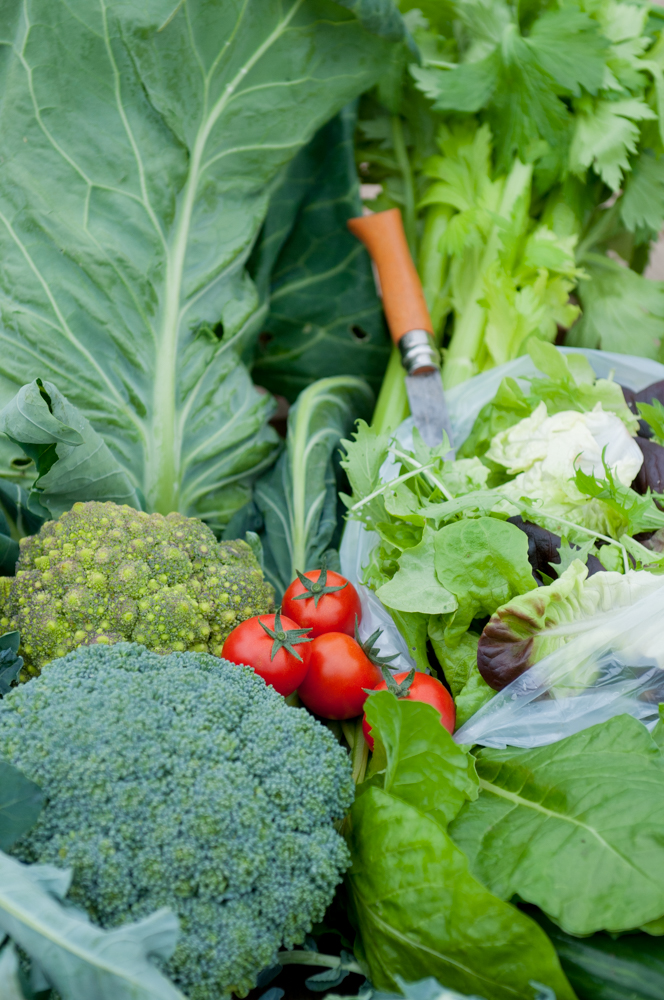
Green Earth Organics farm, Kale, broccoli, bunched carrots, parsnips, swede, leeks, spinach, lettuce, salad, onions, celeriac, celery, beetroot, courgettes, cucumbers, tomatoes and more.

So, you see, your support makes a very real difference to us, to Richard (our apple grower) to Emmanuel (our farm manager), to the planet and to all the other farmers that depend on your orders to keep the produce rolling in off organic Irish fields.

As always thank you for continuing to support us.

Kenneth.

When It’s Gone It’s Gone

If Joe, or Ella or Hannah take on the vegetable growing gene, that will make us 5th generation vegetable growers here in the West of Ireland. We are lucky, our model of growing and distributing food protects us, to an extent at least.

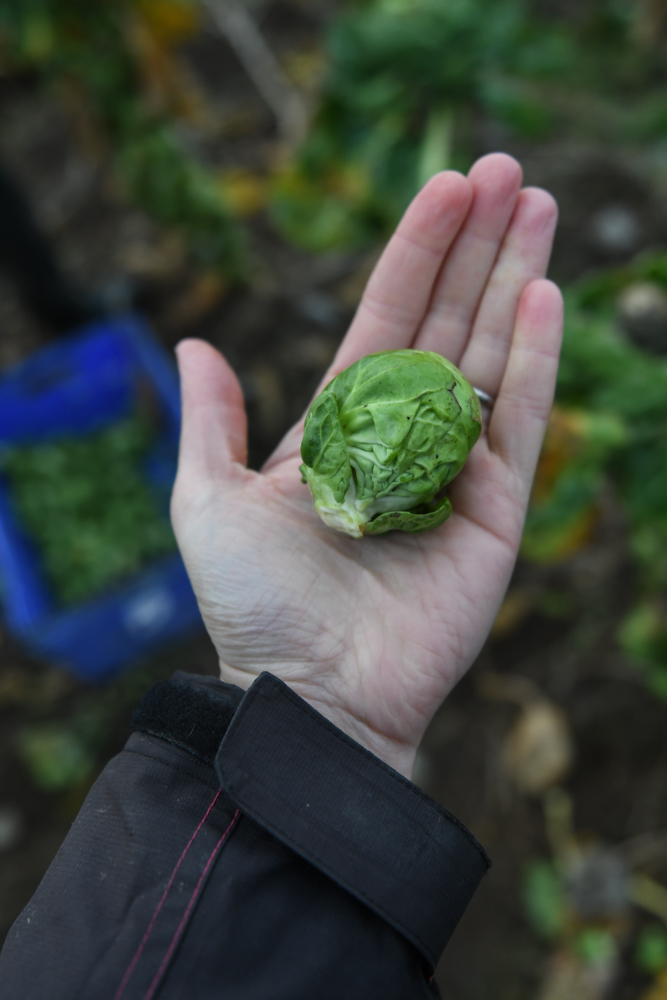
“When it’s gone it’s gone” the words of Cathal Lenehan the second biggest brussel sprout grower in the country as he calls a halt to his farming career for good this week. As prices in supermarkets continue to erode any chance of vegetable farmers in this country surviving, Cathal has put a call out, a plea for them to recognise that farmers just can’t survive on what they are receiving from supermarket buyers.

In 2006 the last of the sugar beet farms closed in Ireland. A whole industry disappeared overnight, the skills, the experience, the infrastructure disappeared, lost forever. As we face down the inevitable pressure of producing more food for more people from the same land area, it seems extremely short sighted that there are not adequate supports put in place now to ensure farmers such as Cathal are protected.

Cheap imports undercut the market. Supermarkets devalue our fresh food, they use them as loss leaders. It is all about the bottom line. Supermarkets are in the food supply industry, they have a responsibility to mind their suppliers, pushing them to the edge in the short term, in the long term will not yield stability, resilience or loyalty. Ultimately this will lead as with the sugar beet industry to devastation for the fresh vegetable industry in this country, farms that have been growing vegetables for generations will suddenly disappear.

How sad would that be? Losing the art of being able to produce our own food, the art and skill of taking care of the land, of being able to produce viable healthy food on a commercial scale. That is not something you can just make happen overnight, it is learned over time and passed down from generation to generation.

I have never had any time for the supermarket model of procurement (buying). In 2016 we said good-bye to supermarket supplying for good. We were told one Monday out of the blue we needed to decrease our prices, and collect any unsold produce from the supermarket and reimburse the supermarket for it. We were told there would be no order that week until we complied, they were our single biggest customer, they had all the power. Well so they thought.

We were one of the lucky ones we had our home delivery business to fall back on, and although it was a major financial hit and in the short-term things were very shaky it was the best decision we ever made.

The good news is you made that decision possible. Your support means more than you know. It means we can breathe a little, it means we can plant trees, it means we can rest the ground and allow it to recover between crops, it means we can support biodiversity on our farm. It means we can give the attention to producing healthy happy food for you.

Thank you.

Kenneth

Weed Control & Roundup

Over the last couple of months, I had forgotten how grounding growing food is. On a sunny day or sometimes even better on a wet and windy day walking through the crops, or sampling the fresh harvest, leaves you feelingconnected to the land and alive.  It is easy to forget all of this.  
 
These days it’s very difficult to know how the food we eat is actually produced. How could we be expected to know?  Life is so busy, and supermarkets give us a shiny happy reality that is often disconnected from the real food production processeshidden behind the scenes. 

The end of the growing season is a mad rush it always is and just when you think you are finished you discover you are not. We have finished planting, but the weeds have marched on relentlessly. This warm humid weather is ideal for cropgrowth but also for weed growth. 

This year our work apart from one or two mishaps has kept pace with the weeds. But our approach to weed control is notone of total dominance, quite frequently once you get the crops to a certain size the weeds are no longer a problem. 

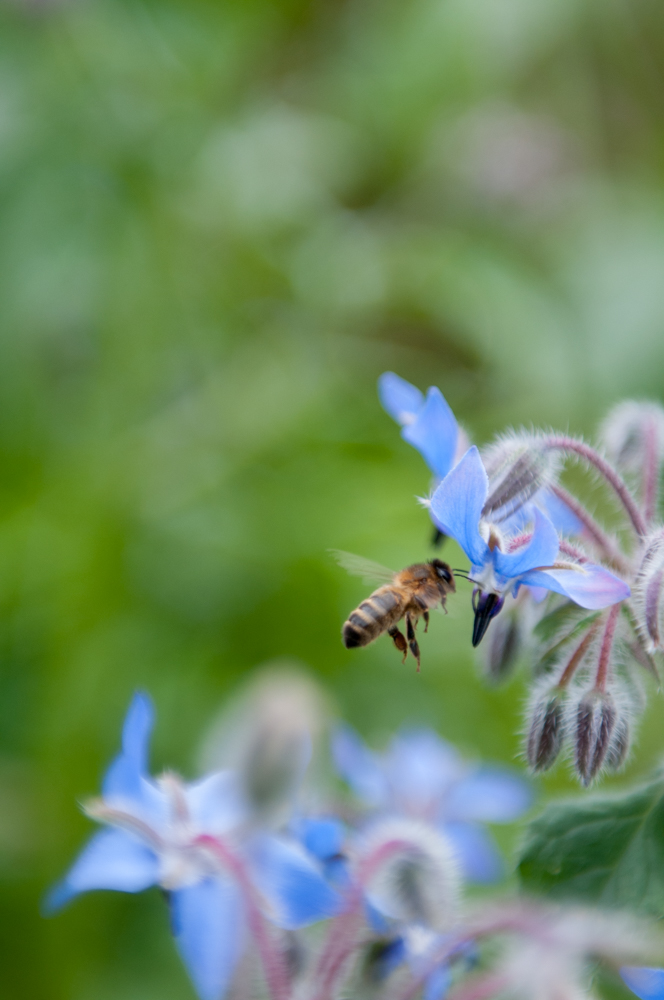
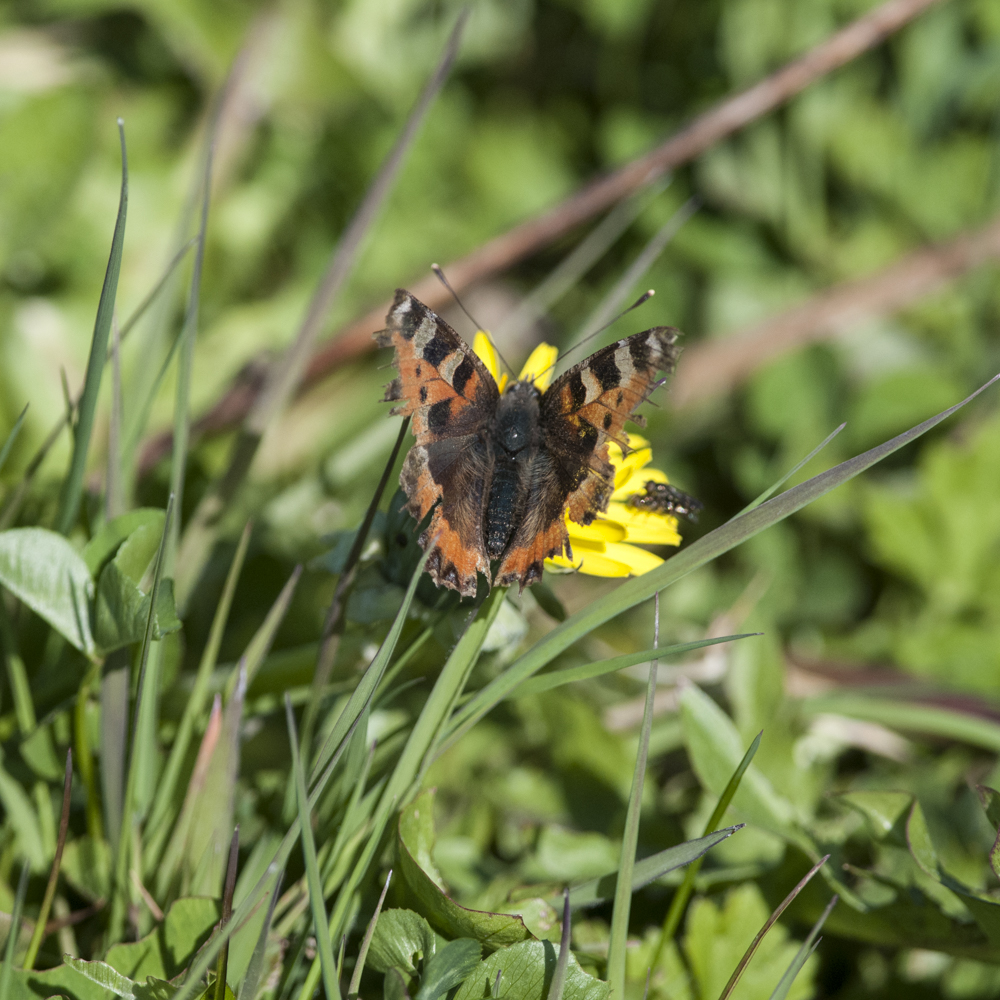
In fact, they can provide a basis for a wide variety of life: flowering weeds that bees come to, the lush green undergrowth, a haven for a myriad of tiny creatures that would not be there otherwise. 

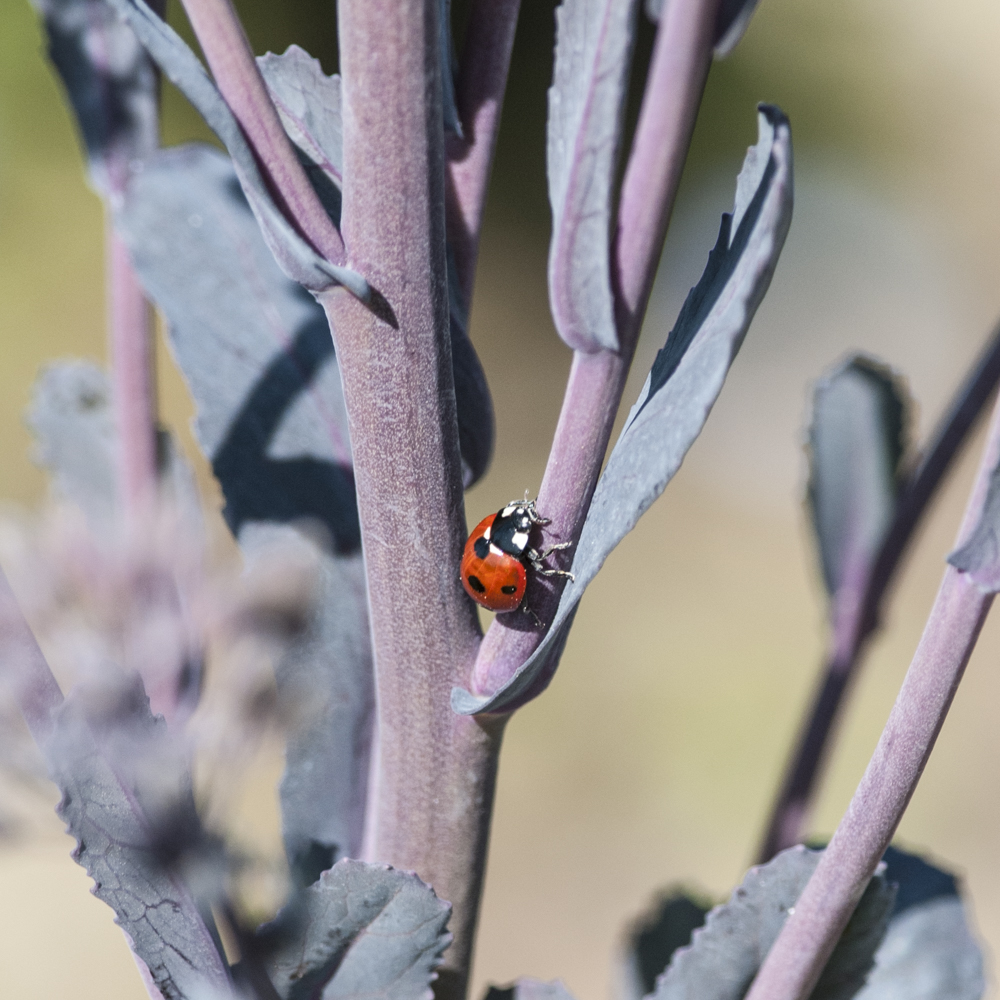
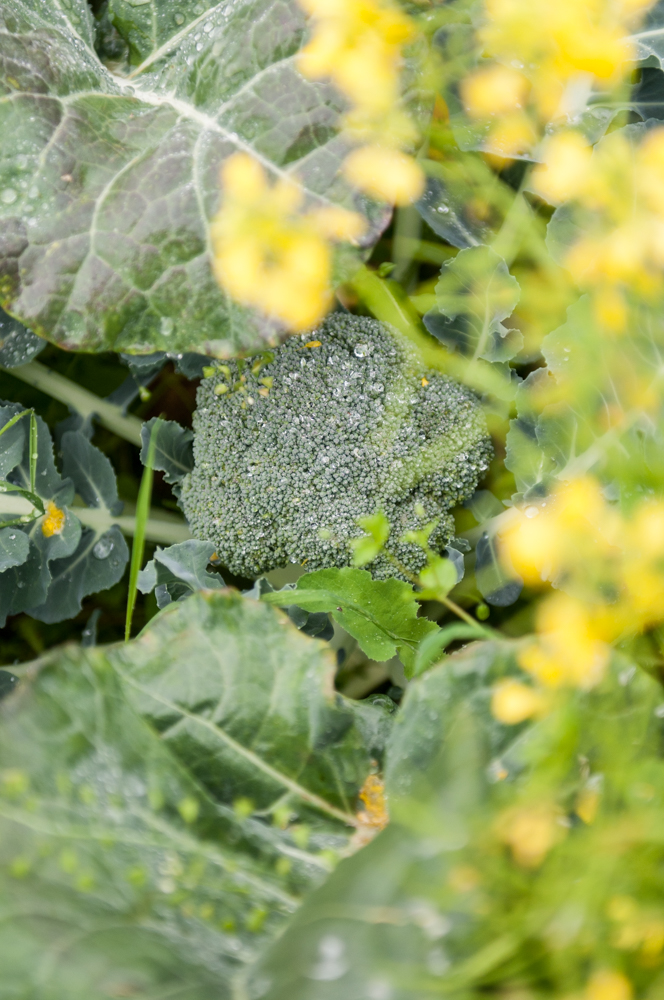
Thus, in turn providing food for the birds, and at times, the necessary predators such as ladybirds and hoverflies that feed on aphids. A natural ecosystem living below the giant shading leaves of the broccoli plants or cabbages develop. Each plant brings something different to the fray and generally none are unwelcome.

Now please do not misunderstand me, if we did not take a pragmatic approach to weed control and utilise all the tools at our disposal there would be no crops, no food, and no farm. We have worked extremely hard to ensure the crops are healthy and weed control is part of the process. No, our approach is just different, less harsh and embraces the idea that yes, we can work with these other plants, and they too have a place on our farm. 

Conversely conventional farming relies on the iron fist of chemicals to control weeds, there is no room for negotiation here, the chemicals are designed to disrupt metabolic pathways in plants, they are generally systemic in nature (get absorbed into the plant and reside there after application, all the way up the food chain onto our plates), the weeds are removed, and the residues of the chemicals remain in and on the food. Just look at the side of any road sprayed with roundup, it is ugly and yellow and dead. 
 
Using chemicals to fight nature will never work. In the short term it may give a temporary reprieve from a certain disease or pest, but that pest will come back stronger and more resistant next time. It is in a way a self-perpetuating industry.It is not the way and IT IS CERTAINLY NOT OUR WAY.

Organic agriculture is much more than saying no to the use of chemicals, it represents a holistic approach to working with nature, to our land and to our food. It means no chemicals, but it also means no artificial fertiliser, it means tree planting, it means hedge planting, it means allowing nature its place to thrive while also producing food. It means taking care of the soil and it means producing food that tastes fresh and good and crucially is good for us and for the environment.

Here’s to fresh organic food!

Kenneth

PS: It is a strange time, normality is creeping back into our lives, kids are going back to school as are ours, routines if there are ones will be re-established. It has been a strange year, some things are certainly outside of our control, but we can control what we eat. Keeping good healthy fresh food in our fridge, means we are more likely to use it, and this means we will eat healthier and feel better, as we head into autumnaldays this is one sure positive step we can take.

Resilience

Resilience is the ability to recover from difficulties. As an organic farmer growing vegetables in the West of Ireland being resilient then is something that you would think is second nature, hmmm???

Our farm may be a little more resilient than most by the virtue that it is smallish (40acres), organic, diverse (we grow loads of different varieties of vegetables) rich in biodiversity (hedgerows, trees, bees, wildflowers) and alive but it is still a constant challenge to make it all work.

In the short-term resilience costs, there is a cost to planting trees and hedgerows, there is a cost to leaving acres to go wild. There is a cost to growing many different crops and managing all the challenges that come with it, the cost of energy and time of training new people each year, the cost of keeping chaos at bay without the use of chemicals.

In the longer term, resilience in our food chain pays dividends, more bees to pollinate our plants, better soil structure reducing water logging and flooding, vibrant and healthy biodiversity that keeps pests in check. Ultimately resilience helps produce better, tastier, healthier food, so instead of focusing on producing things as cheaply as possible, we focus on producing things as sustainably as possible.

But a long-term approach to food production is not something that the major retailers seem to have any interest in. The short termism of the supermarkets may deliver cheap food but in the long run there will be a price to pay.

Endless machine repairs…

But a long-term approach to food production is not something that the major retailers seem to have any interest in. The short termism of the supermarkets may deliver cheap food but in the long run there will be a price to pay.

This is the question I keep returning to. We certainly do not have the deep pockets of the supermarkets and yet to an extent we are competing with them, they set the pricing, they devalue fresh food by loss leading. How can we compete and be sustainable and resilient at the same time? Well, the answer is we cannot, we cannot sell food for less than the value it takes to grow the food! There is no getting away from the fact that to protect our planet we need to produce different food and we need to do it sustainably; we need a fair and resilient food system.

So, I think in our little patch in the West of Ireland we will continue to plan to be more resilient. But this month on the farm a different form of resilience is being tested and we are being stretched to the limit. The weather has not been kind and it is putting us under a level of pressure that I don’t enjoy. Can you be resilient while falling behind with planting and weeding, never having enough resource, of the land being endlessly wet, of uncovering crops and finding 40% eaten by creatures. Endless setbacks bend your will, stretch your ability to stick with it, they make you want to quit, stop, turn back, and give up, but inside all of this messy stuff there is a deep-rooted commitment to keep going, a conviction (even if we can’t feel it) it will be better soon, it always is!

How easy it is to forget though? I am not new to this and after 15 years of farming in the West of Ireland wet ground and excessive rain in June should not be a shock. Maybe then it is just that I am older, and I wish things would be different. I know too in a month it will all look so different, but I find I must keep reminding myself of this. So that too is a form of resilience, to keep going even when you really do not feel like it.

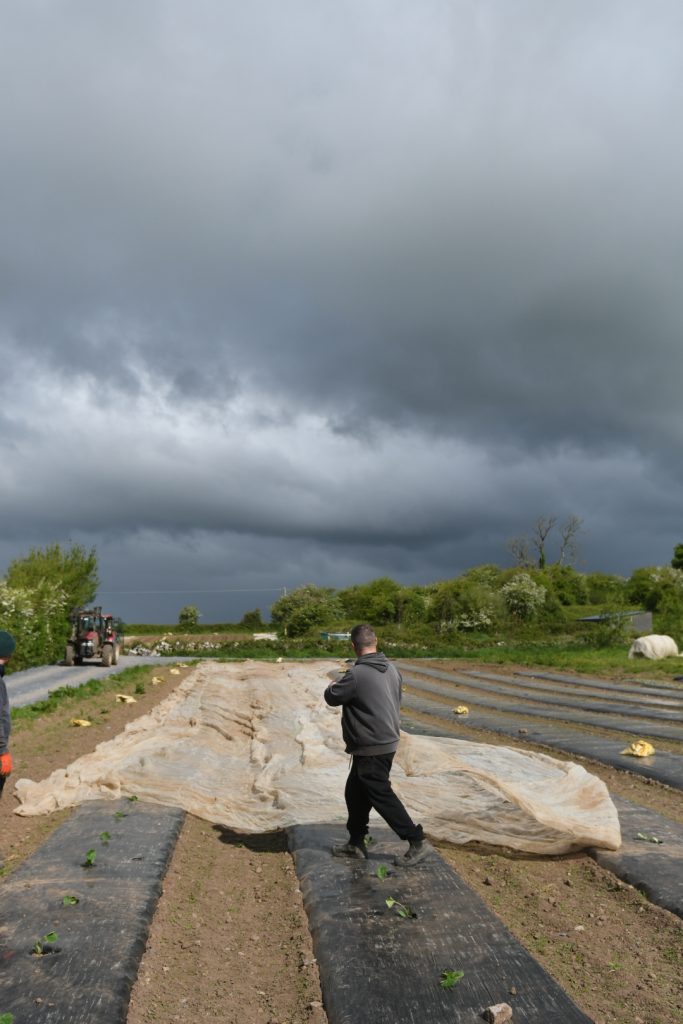
Squashes being planted into bio-plastic, compostable weed suppressant

Here is to each of us being more resilient and to a more resilient food system!

Thank you.

Kenneth