When you go down to the supermarket today, read these labels..

I had a remarkable revelation in the supermarket the other day. As I was browsing the fresh produce aisle as I always do when in a supermarket, I noticed something that really caught my eye.

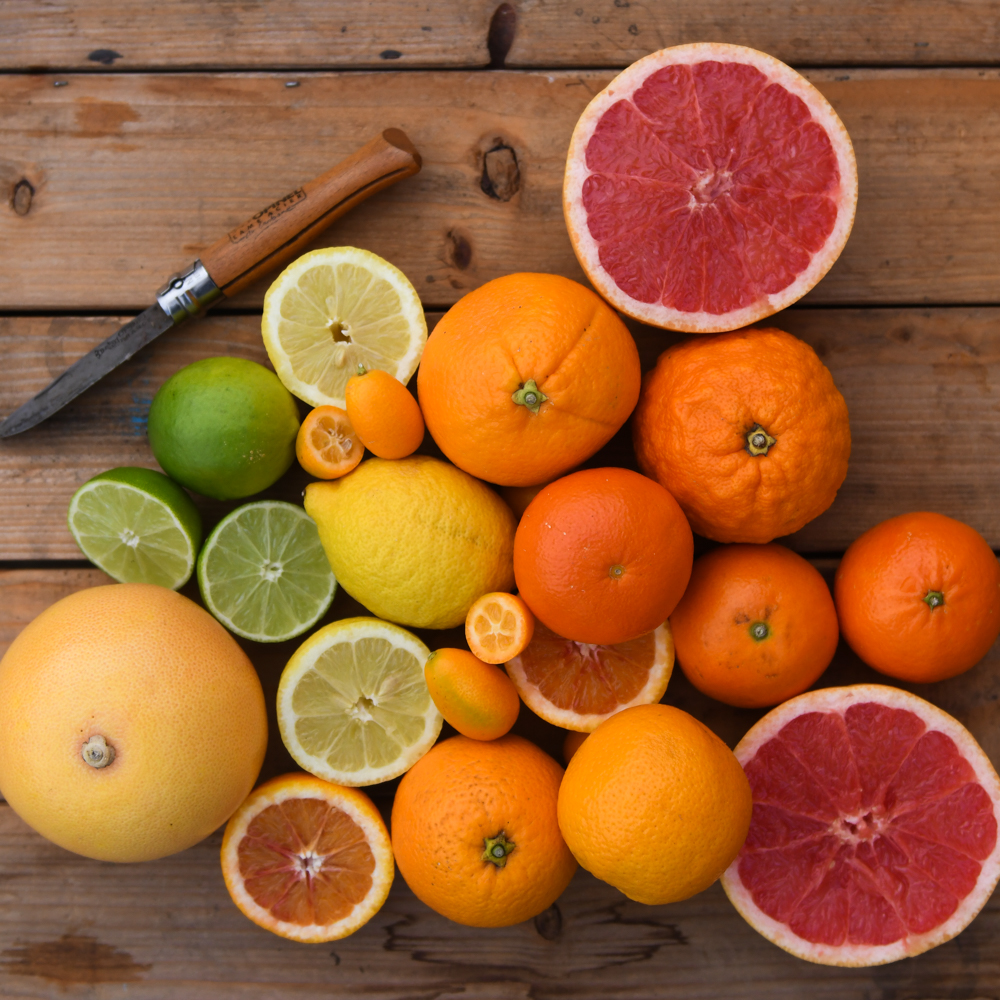
It was actually quiet refreshing for a change. Reviewing each of the labels on the citrus products, they were clearly marked with the chemicals/fungicides that had been applied to the skin of the oranges, lemons, limes and mandarins. A few weeks back I was wondering if the pesticides that were used in growing carrots were highlighted on the pack would we change our behaviour?

And how is it that it comes down to the organic farmer to prove his/her produce is chemical free, why doesn’t the conventional produce list all the chemicals used in the growing of the crop? Well at least with citrus fruit we have the post-harvest treatments clearly outlined, this is the law in the EU.

It was quite a timely consideration as during the week we had one of our annual organic inspections and we were informed a sample of our produce will be sent away for screening for a mind-blowing list of chemicals (870 last time), more on that at a later date.

Anyway, back to the oranges. I am not sure that many people notice the chemicals though as it is hidden away in small print, nevertheless showing all these postharvest fungicides and wax treatments is a very good thing, as we can make more informed choices about our food. It is also worth noting that it is stated on all the labels that the skin is not suitable for eating!!

Here are some of the chemicals I found on the labels and their scientifically linked safety considerations. Also this is for an individual chemical most of the fruit I examined at up to 4 different treatments per piece of fruit.

1) Imazalil: Possible endocrine effects. The EFSA (European food safety authority) has evaluated imazalil repeatedly; the substance has raised endocrine/ecotoxicity questions in the past. Carcinogenicity concerns: possible/likely carcinogen based on animal data.

2) Thiabendazole EFSA peer-review concluded thiabendazole can affect thyroid hormone systems in animals. That is an important regulatory finding. Carcinogenicity/reprotoxicity: animal studies have shown some reproductive/developmental effects at high doses.

3) Pyrimethanil: Some experimental studies show reproductive or developmental effects in animals at high doses.

4) Fludioxonil: EFSA identified fludioxonil for endocrine-related effects.

5) Boscalid: It can be persistent in the environment

6) Azoxystrobin: Some studies indicate potential for oxidative stress and endocrine-related effects in experimental systems.

I am sure there are more, and this excludes the waxes that are also used to coat most conventional citrus fruit.

Not an entirely benign concoction, and not a cocktail of chemicals that I would particularly like to have on my food, thank you very much. I am sure you are wondering how an orange is not suitable for vegans. Well, one of the waxes that can sometimes be used, in particular E904 or Shellac (this is a resin secreted by a bug!), make the fruit unsuitable for vegans!

So, if you do buy conventional citrus fruit, please note again that it is advised that the skin is basically inedible or unsafe due to these chemicals (read the labels it actually states it there) so please don’t use the zest for cooking, much better to choose organic, and if you want to steer clear of these and other chemicals better where you can to choose organic entirely.

As always thank you for your support

Kenneth

Fake Farms, what do you think…

What do “Egan’s” and “Farrell’s” have in common?

They are all brand names used on supermarket packed own label fruit and veg. They give you the impression that they are family farms, BUT THEY ARE NOT.  They are marketing mechanisms, to make us feel warm and happy that we are supporting these assumed lovely family farms.

We are working hard on our Real farm to get the autumn harvest out and the conditions are favourable; this is the same in the remaining Irish vegetable farms up and down the country the likes of Beechlawn Organic farm, or McCormacks Family farm, or Philip Dreaper’s farm in Offaly where we get our Irish carrots, or Richard Galvin in Clashganny organic farm who supplies our organic Irish apples, and many, many more.

These family names used in some supermarkets give the impression there is a real farm with a family name behind the carrots, or tomatoes on their shelf. I recently went to check this out in a large Retailer.

In their fruit and veg section I was convinced that “Farrell’s” which was labelled on much of their Irish produce was a family farm and this family were producing a wealth of produce. At least at first glance that was my impression. I’m in the veg growing business I am a grower and understand a little of how these things work and I was taken in by the misleading advertising.

As I looked a little closer it seemed that my original assumption was not at all correct. “Farrell’s” is not a real farm; it is a marketing tool created by the supermarket to give the consumer that warm homely glow of things being done right.

Does it matter?

Well, I think it does, firstly, this is misleading, you are led to believe the produce is coming from “Farrell’s”, and it is not.  

The second interesting point that is worth considering is that this brand allows supermarkets or more frequently large pack houses and distribution centres, to take in produce from multiple farms and blend it into packs, so the carrots may be coming from multiple suppliers and you or I will never know.  This practice is now frequently called “blending”.

This is very helpful for large retailers as it gives it them the balance of power when it comes to price negotiation, and the ultimate flexibility to choose whose carrots or apples to put into their bag.

When the grower is hidden, he has less power to negotiate a fair price and as with all own branded products on supermarket shelves they are cheaper. It is this pricing structure that has done the damage to growers all over Ireland over the last twenty years.

As always with your support our real Farm continues to grow and our support for other REAL growers can be fair and transparent.

Thank you.

Kenneth

PS Thank you to everybody who donated to our Gaza appeal during the week, I am waiting on final confirmation but the total donated is looking like it was €2380, so thank you so much to everybody, we will be topping this up with the 50% of €1190 making the total donation we will make to the UNICEF Gaza appeal €3570. We will confirm this early next week and be making the donation straight away.

I have had enough, have you?

The model of loss leading on fresh produce needs to stop, how is it that the cheap ultra processed rubbish food is not cheap, this is food that isn’t even food, why is it that our most valuable food, the real food actually grown in fields is sold at prices that are unsustainable?

During the week I had the honour of talking on a panel at the Climate Carnival on the future of food in Ireland. One of the speakers was the largest broccoli grower in Ireland, and he was very clear in conveying his opinions on supermarkets, and it was a damning verdict. The behaviour of supermarkets over the last 20 years has decimated the horticultural industry in Ireland. There are maybe only 60 growers left in Ireland growing field scale vegetables.

When the skills and infrastructure that provide us with local food are gone they are gone for good (just looked at what happened to the sugar beet industry in Ireland). There are very few people interested in getting into commercial veg growing and why would you? For low returns? For the hard work? For the unpredictability of the climate and then to be pressurised and squeezed by supermarket buyers that hold all the power. That is some thanks for providing our critical nourishment.

The truth of the fact is the supermarkets use fresh produce loss leaders to get shoppers in the door, and there is no escaping the fact that this squeezes the primary producer it always does, always.

Fresh veg for 49c, it is an illusion to think that food can be grown for this. The reality is that whilst these prices may be perceived as good by the consumer the long-term viability of these offerings is absolutely unsustainable, and we will pay in the long run. Not only does this desperate pricing model embed the idea that fresh produce is virtually worthless, but it also reduces the bargaining power farmers have when they come to renegotiate growing contracts in the following year.

If we lose anymore veg growers in Ireland there will be no horticultural industry left. We simply cannot afford to, if you consider food security, it is so important and with the climate in free fall, being able to grow as much food as we can here in Ireland is critical.

Not only do the supermarkets not play fair they also impose quite frankly ridiculous ultra-tight specifications, meaning vegetables must look a certain way and be of a certain size or they are rejected. For the sake of all that is sane, this needs to be stopped immediately. The model of loss leading on fresh produce needs to stop, that is the bottom line. Our most valued commodity, the stuff that sustains our life force, that can be a force for good needs to be protected and celebrated, not beaten down until it is no more.

As always thank you for your support for our farm and the farmers we support

Kenneth

Irish organic apples….. There are only 35 commercial apple growers left in Ireland

Some 95 per cent of apples eaten in Ireland were grown elsewhere. Today there are only 35 full-time commercial apple growers in Ireland, down from 50 in 2017. And 40 per cent of all the apples grown here are Bramley cooking apples. (link to Irish Times article https://www.irishtimes.com/food/2025/09/06/the-secret-world-of-irish-apples-why-are-they-so-juicy-and-why-do-we-import-most-of-those-we-buy).

There were over 400 Irish commercial veg growers in the 90s, today that number is just 60, and we are one of those. We have just had the first delivery of Organic Irish Elstar apples from Richard Galvin in Waterford, and I have to say they are some of the finest apples we have ever received, they are amazing, well-done Richard.

We are serious about supporting Irish suppliers, as you may know we grow loads of our own organic veg, but we also support a wide range of other Irish organic growers. We I believe have the distinct advantage of being both a grower and a retailer, we get to see both sides of the field (no pun intended, oh dear..) so to speak. In fact, it can seem quite weird some days sitting in a meeting with our main fresh buyer Anna and our farm manager Emmanuel, and discovering that nobody will end up happy, not enough for the farm and not enough to run the retail business, and not enough to compete with the crazy discounted prices of supermarkets.

But the key difference between us and the general run of the mill supermarkets is that we actually do what we say. So instead of putting smiling Irish farmers all over their lovely supermarket walls maybe they should back that up by actually properly supporting Irish producers and paying fair prices and buying more Irish produce when it is available at a fair price.

We will always buy Irish first and foremost, always, and we always do. To be honest even when it is more of a pain than a gain and that sometimes too can have an impact on perceived value, because it is always, always more expensive to buy. One thing I know for sure is this, we have tonnes and tonnes of Irish organic produce right now, quite literally and we certainly have Irish apples and not only from one Irish organic farmer but two. I could list out all the other Irish farmers that we partner with or buy from, but that might be boring, but do you know what? I think I will anyway, because it annoys and upsets me that we work so hard, and supermarkets get to do whatever they want and present this idea of being the biggest Irish supporters when it just is not true, and they get away with it because they have all the power, (I think we have seen enough of what people with power do in the world today and how much havoc that can wreck on our people and planet, you know who I am talking about here)

So here goes in no particular order: (So these growers are not only Irish, but also all organic too) in total 18 Irish organic farmers.

Joe Kelly, Mayo – cucumbers, yellow courgettes, radishes, lettuce, coriander, parsley, French beans

Philip Dreaper, Offaly – carrots, beetroot

Cameron – Battlemount organic farm, Kildare, potatoes and apples juice.

Richard Galvin, Waterford – apples, apple juice, apple cider vinegar

Audrey and Mick, Galway – parsley, chard, salad mix, rocket, spinach

Padraigh and Una, Beechlawn, Galway – fennel, spinach, onions, cabbages, celery, leeks, beetroot, scallions.

Darragh Donnelly, Dublin – cherries, apples

Banner Berries, Clare – blueberries

Culinary Microherbs, Dublin – MicrogreensGarryhinch, Offaly – exotic mushrooms

McArdle, Antrim – chestnut, portobello mushrooms

Roy Little – leeks

Alison, Slieve Bloom organics, scallions, radish.

Oranmore Farm, Raman – occasionally, French beans, salad mix

Sloe hill Farm – occasionally, herbs (basil, parsley)

Paul Brophy, Kildare, Broccoli

Emmett Dunne, Carrots

Green Earth Organics farm, Kale, broccoli, bunched carrots, parsnips, swede, leeks, spinach, lettuce, salad, onions, celeriac, celery, beetroot, courgettes, cucumbers, tomatoes and more.

So, you see, your support makes a very real difference to us, to Richard (our apple grower) to Emmanuel (our farm manager), to the planet and to all the other farmers that depend on your orders to keep the produce rolling in off organic Irish fields.

As always thank you for continuing to support us.

Kenneth.

Irish apples, picking apples, and the Dirty Dozen…

I remember as a young lad having to climb trees to pick apples in my grandad’s orchard. Having been pruned and tended to over the years they had grown to to a very decent height (you needed a tall ladder to get to the top apples) these apples were never ever sprayed, and when they were picked they were stored on galvanised sheets in a cool shed, providing apples until nearly Christmas. Any those that had blemishes were used first.

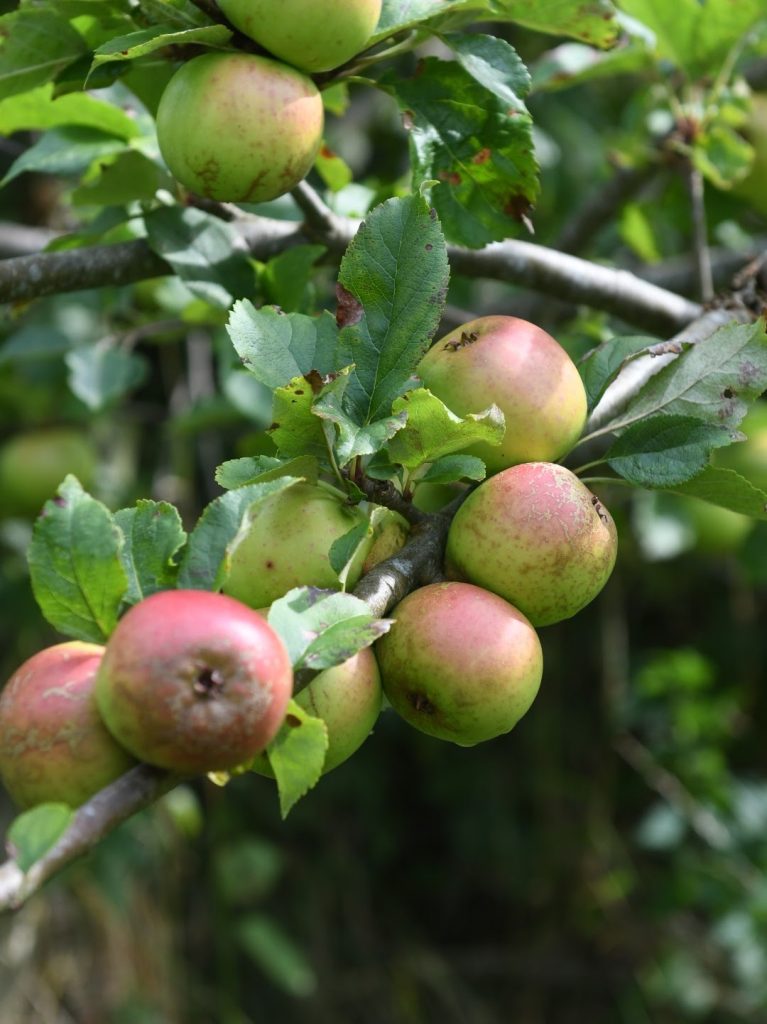
During the week I was speaking to Richard Galvin who has been our Irish organic apple supplier for nearly 10 years. His apples are wonderful; they are Irish and organic and crucially are not sprayed with any synthetic chemicals. We have been receiving excellent organic apples from a Fairtrade co-op in France and from Darragh Donnelly in Dublin, and there have been some issues, at least if you were a supermarket there would be an issue.

The issue if you would call it an issue is that some of these apples are not perfect, they have slight blemishes on the skin, some of the blemishes are not ok to send out and as a result we need to grade and examine every single organic apple by hand. We do this and that is ok, but it takes time and people.

Now contrast this with the perfect apples that grace your average supermarket shelf. How do they end up so perfect and end up lasting for so long?

There is a reason that they look the way they look, and a big part of that is the synthetic chemicals that are used in their production.

Apples nearly always feature in the Dirty Dozen, and although this is a US survey, there is plenty of research demonstrating that European apples, or in fact many of the apples imported into Europe from further afield have plenty of pesticide residues on them. Apples are one of the most sprayed fresh products you can buy. A recent survey in the Netherlands found chemicals in every single sample they tested (1 click here for the article). Some had a cocktail of residues.

In Ireland in 2022 the department of agriculture tested 70 different samples of apples, 55 (or 79%!) had pesticide residues and over 4% had residues deemed as unsafe. If you would prefer not to have pesticides on your food (whether they were deemed to be below the safe limit or not) the fact that nearly 80% of all samples tested right here in Ireland had recorded pesticides is enough to make up my mind. (2 click here for the data and go to page 138)

There may be an argument to be had that these chemicals help reduce food waste, and that has a certain validity, but on the other hand, if supermarkets were happy to sell apples that did not need to look like shiny plastic apples, then maybe there would be less need for these chemicals.

Either way, my grandad would certainly not have agreed with spraying his apples, and certainly Richard and Darragh do not agree with using synthetic pesticides either, and we are grateful to be able to share their apples with you.

As always thank you for your support.

Kenneth

Chemical Carrots, you might be surprised…

We have been harvesting our own lovely bunched fresh organic carrots for a few weeks now and this week we received the first delivery of beautiful organic carrots from Philip Dreaper in Coolnagrower in Offaly just outside Birr.

In the next couple of weeks, we are due our farm organic inspection. This is an inspection we pay for to prove that we are carrying out our farming and business in accordance with organic principles. One key law of course is that we must never use synthetic chemicals. We must be certified organic by law to call our produce ‘organic’.

We would never use toxic pesticides or herbicides anyway, as farming without chemicals is why I started the farm.

But the question is why do we need to prove we are organic? Why isn’t the responsibility on conventional food producer to label the pesticides used in growing certain crops? (don’t get me wrong organic certification is definitely necessary in the world we live in today)

Back in my grandad’s day, there were only ‘carrots’ and all carrots were organic. They just were, because no synthetic chemicals or fertiliser was used in growing them.There were no sprays, no synthetic pesticides, herbicides or fungicides, nothing. That is exactly how we grow them today, we sow seed, and we cover the crop with netting and then we harvest end of story, no spraying at all.

These synthetic pesticides are labelled… “plant protection products” sounds so much better than “pesticide” don’t you think? Making these toxic chemicals sound more benign, even good for the planet and our health. It sounds like spraying these chemicals is doing us all a favour including all the bees and biodiversity the application of these “PPPs” is doing something good for the world in using them. This couldn’t of course be further from the truth, they are hurting our health and destroying biodiversity. In addition did you know it is mostly the manufacturers that produce the safety related data for the chemicals they sell, a conflict of interest there? I would say so. So if your supermarket label listed the following on your conventional carrots, would you still buy them?

Ingredients: may contain,“Carrots, Glyphosate, aclonifen, prosulfocarb, clomazone, prosulfocarb/stomp, fluazifop-P-butyl, propaquizafop, quizalofop-P-ethyl, fluazifop-P-butyl, azoxystrobin, fluazinam, cyprodinil+fludioxonil, boscalid+pyraclostrobin, tebuconazole/trifloxystrobin mixes”

Or would you choose organic carrots where the label would say:Ingredients: contains “Organic Carrots”

I know which one I would choose.

As we supply directly to you our customers, it is only through your continued support that we can continue to produce healthy food and spread the message that our food choices can literally change the world.

Thank you

Kenneth

   Endocrine disruptors and glyphosate

Funny how the universe works, I was seriously lacking inspiration for this blog when a spark lit the fuse. The Spark was Liam Gavin from Carraig Rua bakery (all good Liam!), he rang as I was just about to take one of his gorgeous sourdough loaves out of the oven. Just so happens I was back from a cycle where I was noticing more of the Roundup sprayed ditches, you know the ones, they are yellow and dead.

In 2024 there were potentially 1.14 billion kgs of Glyphosate produced, with estimated sales of over $10billion, that’s a lot of herbicide for your money. Seems it is still in widespread use. The question I guess we should be asking ourselves is does consistent low-level exposure of this chemical and other pesticides cause health issues.

Paracelsus said, “Solely the dose determines that a thing is not a poison.”

 This is often an argument used to promote the safety of pesticides in general that the “dose makes the poison” as in you need more of a certain chemical for it to cause damage.

But when it comes to hormone disruptors (many pesticides are hormone disruptors) low doses can have big effects (they act at parts per trillion, which is nearly nothing) they can cause damage and they have been implicated in many chronic diseases, such as cancer and diabetes.

Cereals (Wheat and others) in Ireland and all over the world are sprayed with a whole host of pesticides, herbicides and fungicides, conventional cereals in general can get a substantial coating of these chemicals.

Herbicides are used to clear the ground such as the usual Glyphosate and others such as 2,4-D which is a hormone disruptor.

There is a myriad of fungicides applied to cereals many are from the azole family which again are hormone disruptors.

Then my favourite are the growth inhibitors that are sprayed on conventional cereals to stop them growing so they don’t “lodge” fall over in the rain such as Chlormequat chloride (CCC) which is also a suspected endocrine disruptor.

While regulators still dispute it, a large body of independent research shows glyphosate can disrupt hormones, especially at low doses, with potential links to reproductive problems, developmental effects, and hormone-driven cancers.

For what it’s worth I do not want to see chemicals sprayed on land or on our food. I think the damage they do to biodiversity, and our health is not worth whatever gains the agribusiness manufacturers claim. And it is the very businesses that manufacturer the chemicals that also do the work to show they are safe, a bit of a conflict of interest there I would say.

Certainly, there is a growing incidence of chronic diseases in modern society and no doubt our lifestyle, stress, overly processed food and the hidden chemicals in our food are contributing to this.

But one thing is for sure there is also a growing number of people that are taking charge of our food, are choosing to eat better and in so doing are protecting our health and the health of our planet.

As always thank you for your support.

Kenneth

Can a bite of an apple transport you back in time….?

Isn’t it funny that if you or I choose to grow our own food we will always, always choose to grow our own food without chemicals! Funny that this is a criterion in our own gardens but less of a consideration when it comes to choosing in a supermarket. My Grandad grew peas, and turnips, and carrots and potatoes as did my dad. My mum had raspberry bushes, blackcurrants, and goose berries. We were picking and eating our own fruit and vegetables and that was in the 70’s and 80’s. What happened?

Where did all the back garden growing go? Not only that where did all our commercial veg growers go?

In our 20 years we have seen so many changes to our food system we have seen the number of vegetable producers here in Ireland fall dramatically to just 60 commercial field scale producers, down from over 400 in the 90’s. Supermarkets have had a hand in this, squeezing the farmer to the extent that there is just nothing left. The consolidation of the packing and distribution process into the hands of a few middlemen has not helped either. In the space of just one generation, we have become disconnected from our food. Where is our food grown, who grows it, how is it produced, how is it handled? This disconnection is not our fault.

We have had school kids come on to our farm and been completely mesmerised by the fact that carrots come from the ground, having thought they begin their life on supermarket shelves in the plastic packaging. So it is that the shiny plastic packs that line the supermarket shelves give us the impression that our food system is unlimited, vibrant and fair, but of course this is not the case. The problems occur when we try to apply factory type controls to a natural system, but nature is not a factory, and the same rules do not apply.

Covid seemed to rekindle our interest in food. People are really interested again, interested in where our food comes from, what it’s impact on our precious planet is, and interested in how it has been grown. This is a wonderful change. We here on our farm certainly know where our food comes from, and we know that it has been produced without chemicals.

This week we have taken delivery of the first pallet of Irish organic apples from Darragh Donnelly in Dublin he also grows the Irish organic cherries we had earlier in the season. These apples are quite frankly amazing, the flesh is a bright pink, I have never seen apples like this, and the great news is this colour is caused by anthocyanins, which are powerful antioxidant and anti-inflammatory compounds.

But the best part of all is that these apples will take you back in time. They took me back to the orchard my grandad used to have in his back garden, the apples there which I picked as a young lad were full of flavour. I believe there is a distinct flavour and taste to an Irish apple, and Darragh’s apples are that if they are anything.

We have so many crops coming from our own farm, and we certainly know how they were grown, what field they came from, even what part of what field they came from! In fact, we could probably tell you who harvested them and who packed them into your box and who delivered them. Now you would be hard pushed to get that level of traceability and understanding of where your food comes from in a supermarket.

It is exciting to see that our food and our food producers are becoming a revered part of our culture again, thank you so much for being part of that transformation!

Kenneth

Just a ‘Touch of Roundup” and you will be grand…

20 years ago, myself and my dad were out with two hoes dealing with the weeds on the vegetable ridges. It is worth being mindful this this was probably the height of the ‘Celtic Tiger’ boom and for two people to be out in a field weeding was as far from the reality of the ‘Celtic Tiger’ as you could get.

So it was, that an interested party came up to see what we were doing out there in the middle of the field, such an unusual sight at the time. A funny conversation ensued; it went something along the lines of:

Him: “What are you at there?”

Us: “We are weeding”

Him: “Why in the name of God are you doing that? It is an awful waste of time”

Us: “Well, if we don’t weed the crops, we won’t have any produce”

Him: “But Surely all you need is a TOUCH OF ROUNDUP”

All I can say that after this brief interchange, there was little in the way of mutual understanding shared on that particular day, in the end, in the nicest possible way we had to agree to disagree on our approach to weed control and I asked the man if he was not going to help us, to let us be as we had quite a bit of work to do.

There were many funny incidents in those first early days. We actually had the local Garda visit to investigate what mischievous plants we might be growing in our polytunnel one evening. To be fair to both protagonists above it is worth noting that a polytunnel in the west of Ireland would have been a thing of rare occurrence back in those days. Not so much anymore.

In fact, in the space of 20 years there has been a vigorous interest in growing our own food again, at least in the small-scale regenerative way. It seems sad to me that the opposite has happened to many of the larger conventional vegetable producers. 20 years ago, was just about when supermarkets started to take a very mercenary approach to dealing with many of the larger conventional growers in the country, and supermarkets have been instrumental in bringing the horticultural industry over the last two decades to its knees.

It is even sadder to think that the price of this destruction could be for as little as 5c on a head of celery.

It is funny too how supermarkets will fight for that 5c and squeeze the primary producer and at the same time post billions of euros in annual profit. But maybe we are all a little guilty of seeing food as a commodity that needs to be as cheap as possible?

Either way quite a bit has changed in the last 20 years, there are now only 60 commercial growers of field scale vegetables left in the country down from around 400 in 1998. But it is not all doom and gloom and there have been many new smaller scale organic and regenerative startups which shows that there is still an appetite for growing vegetables and doing it without chemicals.

As always thank you for your support, without which we would not be here today.

Kenneth

PS Thank you to everybody who has supported us through the summer. As we head into September and back to school, this is a time that is just as important for us as we have so many great crops from our farm and from our other farmers, and we need your support, what better time to get back into a routine with the very best Irish organic produce.

PPS We have opening currently for full time packing staff, if you would like to join our team please click here for more details.

Do chemical cocktails give you a health hangover?

Now I am going to go out on a limb here, but if you have ever consumed alcohol, you may know that mixing your drinks does not produce a great feeling the next day, the hangover that can ensue can be quite horrendous, (so I have been told….). Truthfully, having experienced a few in my day, it has often been said if you forgot you were drinking the night before and work up feeling like you can feel after mixing your drinks, you might actually think you were dying!

So it is with chemicals, and this is something that cannot be measured and is not very well understood, but picture consuming small amounts of pesticides regularly in our food, nobody actually knows what impact this may have. Some research suggests overtime the results may be quite detrimental to our health.

Certainly, over the last 20 years, the application of chemicals on our food here in the EU has reduced, with many of the more toxic chemicals being banned. This is a great thing, and we can be thankful to the EU for this control, despite chemical company lobbyists issuing misleading information that we could not produce enough food without these chemicals.

The spraying of our food with synthetic chemicals is just not good for us. All the studies in the world, even if they demonstrate that the chemicals are safe, are not going to convince me that it is ok. Filling a giant tractor sprayer and going out into a field on a scale that has never been seen before and spraying everything in sight, is like taking a sledge hammer to put in a pin in a wall. This is what is happening, there is no selective application, it is blanket application of chemicals and everything gets a  coating, plants and biodiversity alike.

Now maybe these chemicals are safe in certain doses under certain lab tests, and that may well be the case, and I am not disputing that, I have spent long enough working in a lab to understand that. I also know I wore gloves, and used extraction hoods, and took great care when handling any of these lab-based chemicals.  But a field and our food is not a lab.

There have been some studies done on the cocktail effect of chemicals in our food. A 2012 EU-funded project called ACROPOLIS studied cumulative pesticide exposure and concluded that current risk assessment systems may underestimate real-life risks.

A 2021 review in Environmental Research noted that low-dose pesticide mixtures may contribute to hormonal disruption, cancer, and neurodevelopmental issues — particularly in children.

It is hard to know for sure, and probably close to impossible to prove, but if you wish to minimise your exposure the best way is to know your ingredients, to cook from scratch, know who produces your food and know that they are not using chemicals, organic produce is the best way to keep chemicals out of our food chain.

As always thank you for your support.

Kenneth

PS Your support over the summer has meant so much, we have so much great produce and your help makes all the difference to our farm, so if you can continue to support us, it makes a real difference, thank you.