News from the farm

The art of producing food is marvellous and tough and on sunny days it is a privilege.

We talk about food all the time here, we grow it, we sow the seeds, we watch the plants grow, we fertilise the soil, we control the weeds and hope we have the right mix to ensure the plants grow healthy and pest free.

We spend the time in between managing the crops, maintaining the land, planting trees, growing hedging, sowing wildflowers for the bees, harnessing the power of the sun, these are all things we do.

We see first-hand the connection between the fresh produce and the cooked food on our plate. We can see how the process of growing healthy food from healthy soil creates local employment and impacts on our locality positively. Sustainable agriculture is good for all and it benefits the environment immeasurably.

We see more bees, and flies, and insects on our farm and we feel there is a balance as we rarely see an out-of-control pest issue. We see more birds, and wildlife, we see the land thrive, just this morning I saw a giant hare saunter past one of our polytunnels.

Not only that, but organic food is so much better for us, of course it hasn’t been sprayed and so is free of harmful chemicals, but it is also just better nutritionally.

A comprehensive study carried out by David Thomas has demonstrated a remarkable decrease in mineral content in fresh produce over 50 years, comparing food grown in 1941 to food grown in 1991. To the extent that today you would need to eat 6 apples to get the same nutritional value you got in 1941 from eating 5 apples. In some cases, mineral levels have dropped by as much as 70%.

The use of highly soluble fertilisers, pesticides and herbicides and the intensive production of food has led to land that is lifeless and food that is less healthy and less nutritionally dense, this reflects the remarkable connection between our food and the health of our soil.

There is no way we could know this, as a population we are in danger of losing our connection with the land and our food. This is not our fault, the food system that is championed by supermarkets and giant food producers has made it this way.

Imagine though if we could see the impact of our positive choices, if we could somehow rekindle that connection with our food? Over the past year it seems we have been remaking that connection.

We are reconnecting with our food by cooking and touching and smelling and seeing how our food is grown. We are redeveloping that connection with nature, and this is something we can pass onto our children, we can show them that there is a great, fun and fantastically positive way to live and eat.

Although from what I have seen recently it is the children who are teaching us!

Kenneth
Ladybirds and biodiversity

We had a decision to make recently, in the grand scheme of things it may not have seemed like a very big one. But if we chose wrongly then it would have taken us away from our core value of biodiversity protection.

We had decided to put in an extra access road on our farm. There was a wall that could easily have been knocked which would make access easier and would have reduced the cost, so from a purely financial perspective it made sense to knock the wall and the growth around it. But as I was discussing this over with Emmanuel, nature gave us the nudge we needed in the right direction.

While we were standing there a giant bumble bee flew past us to nestle right into the grass and brambles at our feet, two little birds flew out of the bushes and as we continued to look we noticed a ladybird. One at first, then Emmanuel pointed out another and another there must have been 10 or more. There was a family of little red helpers there in that wall. This was in a tiny little space full with the vitality of nature.

The decision was made for us, and I was a little ashamed that I had been contemplating knocking the wall in the first place. So, the wall will stay, and we will work around it.

A small price to pay for the richness of nature that calls that little corner of the field it’s home.

This was a clear-cut decision.

When it comes to chemicals the effects can be much more difficult to spot. When chemicals are applied to fields and crops, they don’t just affect the targeted crop. There is no magic bullet, if the years spent studying chemistry thought me anything, it is that the magic bullet does not exist (The idea that a drug or chemical will only target a certain disease or pest without side effects).

So it is with chemicals that are routinely sprayed in nature. These chemicals are broad spectrum insecticides or herbicides. They do damage and they hurt biodiversity. The neonicotinoids for so long proclaimed safe for bees were as it turns out not safe for bees. Glyphosate which heralded a new in weed control has been shown to be a ‘probable carcinogen’ and it is everywhere in our environment now. 

These chemicals are the unseen freebies we get with our food, and they hurt our health. But even more importantly they hurt our land and the life we share this planet with too. 

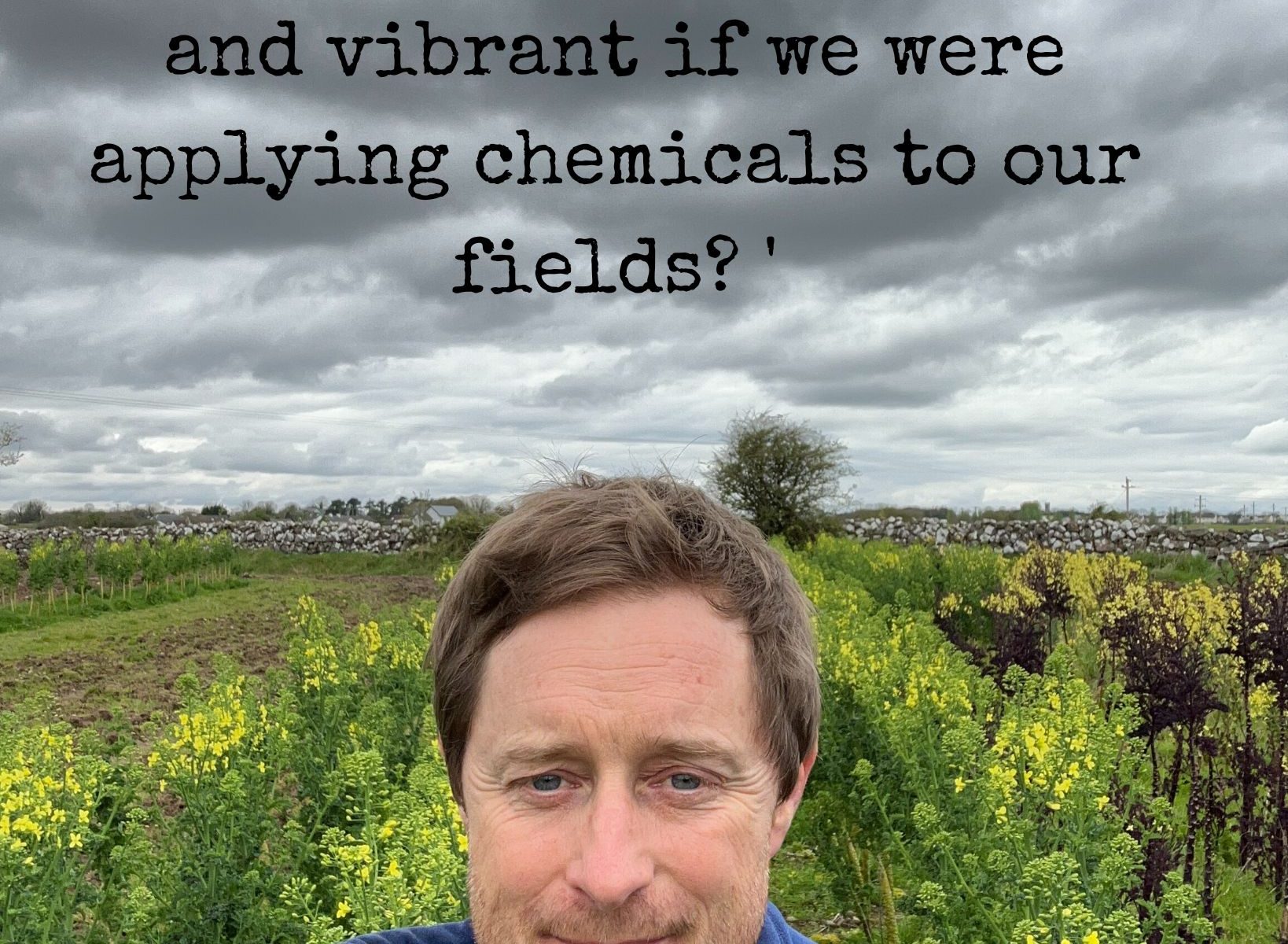
Would that little corner of the field have been so rich and vibrant if we were applying chemicals to our fields? Absolutely not. So, with your support for our business you are supporting many little corners of land right across Ireland, whether it be here on our farm, or Joe Kelly’s farm in Mayo, or Padraigh Fahy’s farm in Galway, or Vincent Grace’s farm in Kilkenny, or Roy Lyttle’s farm in Antrim or Richard Galvin’s farm in Waterford or Cameron’s farm in Kildare or Philip Dreaper’s farm in Offaly and many more.

We all share the same belief that there is a better way to produce food that there is a safer and happier way to farm.

Thank you for your support, and for supporting our mission:

“Better for you, better for the planet”

Kenneth

Good clean dirt

“Good clean dirt” that is how Willie the farmer whom I spent most of my summer’s working with described it.


I am not so sure I appreciated his philosophical outlook at the time, who as a young teenage boy was seeing a little too much dirt and not enough fun for my liking.
It seems though, these days that sticking your hands into a pile of soil is considered as sensible as keeping a pet tiger and this as it turns out couldn’t be further from the truth.
There has been a proven link between a bacterium found in soil and increased serotonin levels in our brain which are responsible for lifting our mood.


There is so much going on under our feet in this top few inches of earth that we never ever contemplate and yet all life and all our food is completely dependent on it. Heathy soil produces healthy food, and as soil is a living entity teeming with billions of bacteria and fungi it is profoundly and adversely affected by chemicals.


I often think it is remarkable how the diversity of nature is mirrored in our body, a healthy gut biome is no less alive than soil. A healthy gut is teeming with life and it is in part this biome that keeps disease at bay and helps us stay healthy.


No more than the microorganisms in the soil, those in our gut do not respond well to chemicals. When we eat food coated in chemicals or consume ultra-processed food, we hurt the good gut bacteria.


Our health is the most valuable commodity we possess, and most of us would trade anything to get back to good heath when serious illness threatens. How we treat our bodes now as a matter of routine will to a large extent determine our future health.
Is it possible to be fit and healthy in our 60’s, 70’s, 80’s and beyond? Of course, it is the natural state of the body, but it cannot be taken for granted that we will live to enjoy health in our later years unless we work at it now and it seems that what we put into our gut has a large role to play in this.


The bacteria in our gut have a myriad of roles and amazingly there is now evidence that points to their part in staving off anxiety and depression. To a large extent the foods we eat determine the health of our gut biome, eating foods that are organic, are high in fibre, are fresh and low in sugar all contribute to a healthy gut.


A healthy vibrant and living soil requires organic matter, and a diverse array of nutrients. Conventional farming treats soil as a chemical equation to be balanced, this is short sighted, a more holistic approach which nurtures the living soil biome produces better food and ironically it turns out that this better food in turn nurtures our own internal biome.


So, it seems that Willie’s philosophy held true. It seems that ‘Good clean dirt’ has on many levels a large part to play in all our well-being.


Kenneth

Loss leaders and multitasking

I am sitting here on our tractor at the bottom of the farm as I write. The tractor ironically being the noisy beast it is, is a great place to find peace. There is something highly satisfying about tilling the land.

As much as there is a business to be managed, the luxury of being in the field at least on occasion is something that really grounds and reconnects a person to nature. Whilst margins and spreadsheets and efficiency ratios are all important all of these things can sometimes cloud the real reason of why it is we do what we do.

Don’t pay enough attention to those variables of course and the tiling of the land is nothing but an idle dream. Pay too much attention and you run the risk of getting lost and losing track of “The why”. It was brought to our attention last week by ‘the traveling stoic’ on Instagram that ‘the restrictive practices order 1987 prohibits the sale of grocery products at below net invoice price’ but this law does not include fresh produce! It is deemed permissible to allow loss leading on all things fresh, and that includes you may be surprised to learn not only fruit and vegetables, but also milk, meat, and fish.

All our primary producers are essentially being told: ‘We don’t value what you do and we will sell your produce for less than the price of production.’ This is upsetting on a number of levels, but especially when you consider the time, energy and care each producer puts into their produce. It is demoralising and financially unsustainable. We know we cannot possibly compete with supermarkets.

As I was writing this on my phone, for some mad reason spell check but in ‘cartels’! maybe that is a more apt description of these institutions!Supermarkets can afford to squeeze the producers, they have all the power, they can dictate terms. This approach has led to more and more growers saying enough is enough, and sometimes over the seemingly paltry sum of 5c per piece.

That is a sad situation. Those skills especially when it comes to vegetables as there are fewer and fewer of us are gone for ever. Many moons ago we decided that we would quit supplying supermarkets for good. It was a decision taken in the heat of the moment, which usually are very poor decisions indeed. We were told one Monday morning that unless we reduced our pricing and became responsible for the waste in their stores we should look elsewhere for custom.

I can’t say here what I said then, but we never supplied those supermarkets again. It was rash, but it meant we doubled our efforts at making a successful business of growing our own food and supporting other Irish growers and delivering direct to you, our customers.

We, only with your help are still here today 18 years later and we are thankful for that. I think Emmanuel (our farm manager) may be getting a little concerned now, not having seen our tractor move for some time. Writing and tiling are very difficult endeavours to multitask at! So, I think it’s time to put the phone down and get back to it.

Until next week thanks for your support.

Kenneth

A funny story about a lorry and a field

Four Guinness Barrels and some scaffolding planks, that was our first makeshift packing table. My dad myself and Jenny used to pack all the boxes and then load them into the back of our small Peugeot partner van. I would head out do the deliveries and the packing week would end with a bottle of wine at about 12am on a Wednesday night, all deliveries done.

Life seemed Simpler then, but our mind often plays tricks on us, remembering the sunshine and forgetting the rain: who remembers summers that were hotter drier and longer when we were kids? (Or were they?).  There was little money for anything, we made do with whatever we had. Jenny was working full time and that was our income.

Our packing week may have finished on Wednesday, but the working week never actually finished. We didn’t have the luxury of somebody to look after quality or packing or the farm, it was all done by us. Now we have great people doing amazing work, the care that goes into the packing each one of your orders certainly puts my early days of packing to shame.

I remember those days of not having a cold room to store our produce and of going out to the local pub carpark to meet the trucks to hand ball and unload some of our bought in produce.

There was one very funny, (well funny now, not funny then) incident where an artic truck came onto our farm, despite insistent communication that there was no way to turn a truck of that size. As I was eating my dinner one evening there was this giant truck parked right outside our house and the delivery driver waving in at me!

The driver decided on his own initiative to turn in our front field, needless to say this monstrous truck got stuck in the muck. Luckily through the kindness and help of two neighbours with very big tractors did we manage to get the truck out of that field.

These were the trials and tribulations of starting out in farming and business and making it up as we went along. But when all was said and done, we did what we did because we wanted to produce and sell sustainable food grown without chemicals, we wanted to do it whilst respecting nature and biodiversity and doing what we could for our planet in our own little corner of the world.

We did that and planted trees and hedgerows and food and got through those first few tough years. It struck me as the bean counters were totting up the figures for last year that although we are bigger now, we are back to the point of having to make difficult decisions to ensure we keep the farm and business afloat.

As Teagasc published another report detailing the pressures facing primary vegetable producers this week, with some farms closing their doors for good, and the amount of land area being farmed for vegetables decreasing due to the financial strain, it makes me wonder when will the value in good healthy fresh food be realised. When will the devaluation of fresh food by supermarkets end, when will they see the “value” rather than the “cost” in healthy fresh food.

As we look to the year ahead there is uncertainty. We are not sure what is to come, nobody is. This is our first ‘normal’ year in three years and for a business and farm it is hard to know what will be thrown at us, but whatever happens we will never compromise on our values.

Thank you for your support.

Kenneth

Solidarity

We all like to feel that we belong to something. At the very least we are all members of the human race, we have a nationality, we are from this county or that. There is of course much more to it than that, and on this day of all days, it seems relevant and right to speak about it.

The great Irish green wave can be seen far and wide on St Patrick’s day, a day when we celebrate being Irish and there are many things to celebrate, and food is certainly one of them.

Ireland is a nation of food producers; you would be forgiven then for asking the question why is it we import more than 70% of our vegetables. There are some pragmatic reasons for this. Next week we will come to the end of our Irish carrots, and we must import to fill the gap, the season is over. Seasonality is a major factor in supply. But when in season there should be no reason not to source Irish vegetables.

The Irish organic vegetable sector is a small niche within the overall Irish vegetable sector, which in itself is small. But there is something that makes the Irish organic sector special.

In my experience the Irish organic vegetable growers that I know are doing what they are doing because they believe in a better food system. They have no interest in putting chemicals on our food, they are interested and actively looking to improve conditions that help biodiversity thrive.  They plant trees, they manage and look after their soil, they are interested in protecting our planet and ensuring that they are doing what they can to mitigate climate change and finally they all want to produce healthy happy food. This I think is a shared and common belief.

Because when it comes down to it, why on earth would anybody start growing vegetables on a small scale in Ireland? Why, when it is impossible to compete with supermarket prices, when it is hard work for little return, there must be a bigger guiding principle.

These growers are opting to take the path less travelled because they believe it is the right thing to do.

The same could be said for you, you may be sitting at home or in your car or wherever you are reading this, you too are choosing a different path. We know it is more convenient to pick up your produce in the supermarket, we know you take the time and make the effort to read our little posts and order from us, some weeks, every week or once in a while.  This makes you part of a community of people that are taking action and making positive changes for our planet, because you value biodiversity and you value eating healthy food.

Earlier this year we planned out our farm, and I wrote about how we have cut back on growing certain crops.  We have passed on the responsibility for producing these crops to others organic growers here in Ireland, we know too that they share our values. At the time this was a difficult decision but now as I look at this in a new light I realise that in essence we are stronger together and that hopefully this small step will lead to a better stronger more resilient Irish organic vegetable sector.

So for the day that is in it, I would like to raise a glass to you for your continued and appreciated support, and to all the other Irish organic vegetables farmers out there, grappling with exactly the same challenges as us, we are all in it together!

Here’s to a greener future!

Kenneth

Children and our connection to our food

Back in March 2019, it seems like an age ago now, just before the world went a bit sideways we had a visit from a local national school of 60 or so excited children.   It was a wet windy and extremely mucky day. The kids were here to learn about food and how it’s inextricably linked to sustainability, healthy eating, climate change, and crucially the health of our land and soil.

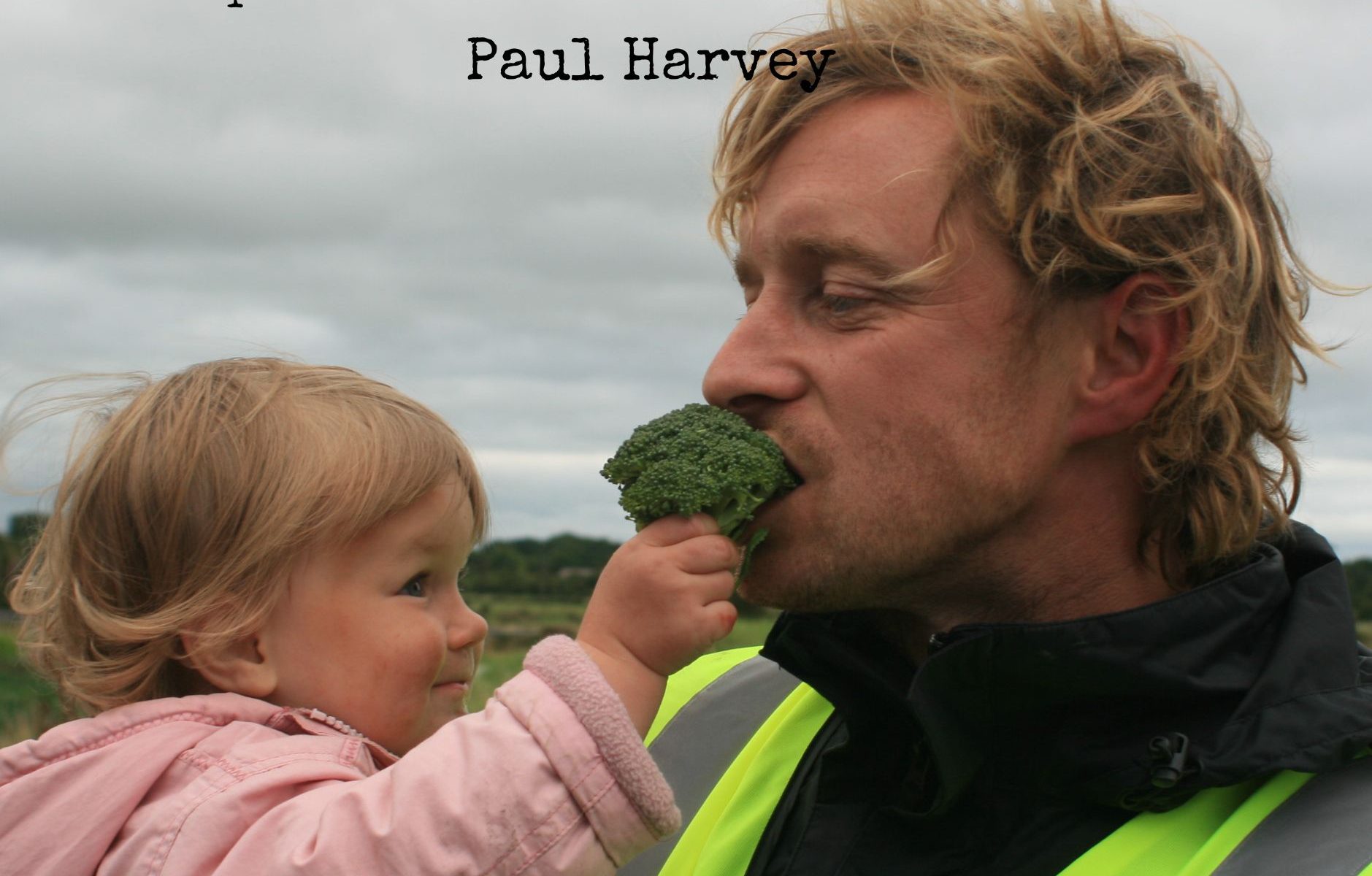
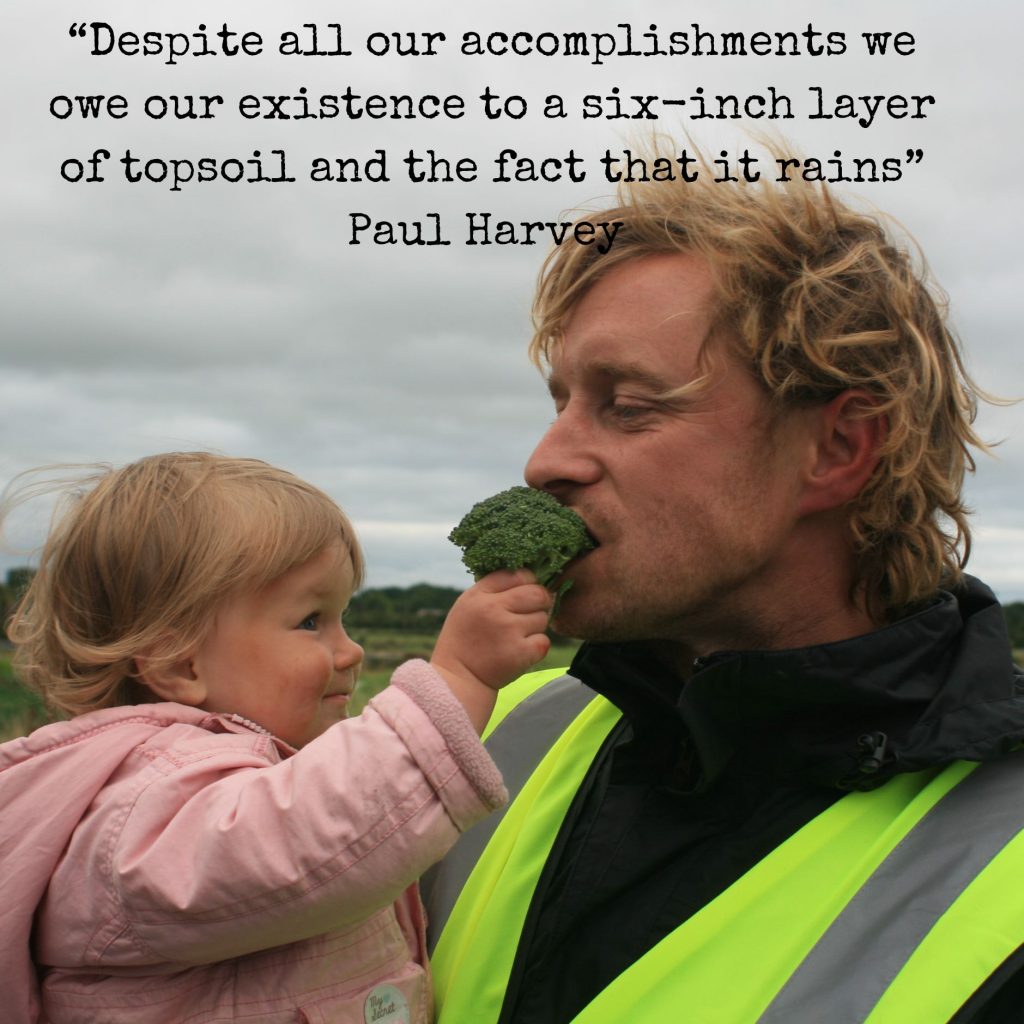
That is me trying to share my food vision with my daughter by getting her to eat broccoli 13 years ago and failing!

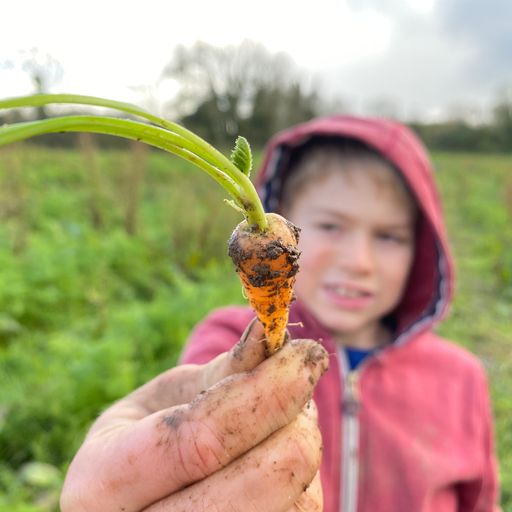
They had such fun. I think my favourite moment of the tour as I was digging carrots was watching all the small hands grabbing and grappling in the mucky soil to pull out those lovely little carrots.  At one stage, in a field completely saturated with muck and water there were sixty children running and jumping all over the place, loving nature and being outside. I did extend a little compassion to the teachers who would have to round them all up at the end of the day!

They were very enlightened little people; they knew about the bees and about pesticides and climate change.

It’s funny that whilst us adults will do all we can to avoid the muck and the puddles, children embrace the messiness of it all. They are instinctively happier outside and seem to have an innate appreciation of the beauty of nature and just get on and have fun whatever the weather, and after harvesting those carrots they were adamant they were going to eat them all for their tea, and I bet they did.

What we as adults do now and the vision of the earth our children learn to see will shape the future of our planet. We are the guardians of that vision, and it would be wise to remember they do as we do; not as we say.

A little example and a little nurturing are all it takes to open our children’s eyes to the value of food. Some of the kids I spoke to thought carrots came from a supermarket shelf not from a field! You should have seen their excitement when they pulled their first carrot ever.

This disconnection from the land and the growing of food is the product of our modern food system. For most of us we are only 2 generations removed from having grown our own carrots.  How easy to change this and re-educate both ourselves and our children about the value of food, about the origin of food, and about the value of the land that we tread upon beneath our feet.

“Despite all our accomplishments we owe our existence to a six-inch layer of topsoil and the fact that it rains” Paul Harvey

We are not all blessed with a little patch of ground… I get that, but we all can manage a little flowerpot on the windowsill planted with some seeds, and how exciting to see the plants flourish. 


Maybe we owe it to ourselves and to our children to find out a little more about how our food is produced?

Kenneth

Good dirty soil and lemons not suitable for vegans…

When I was a young teenager I used to work every summer for a farmer, he had a saying “there is nothing like good clean dirt!” And in fact, there was a lot of truth in that, even though at the time I had no idea what he was talking about.

A customer contacted us during the week and was concerned about the wasted soil on some of our vegetables that gets washed down the sink, and rightly so. We have thought about this long and hard and totally agree that soil management is critical to healthy food and a healthy planet.

Dirt, clay, soil the stuff that gets stuck under your fingernails is good for us. It is actually pretty healthy to get it on your hands, in fact research has shown that getting your hands stuck in clay may actually ease depression. (Mycobacterium vaccae the bacterium is found in soil and may stimulate serotonin production is currently under study)

Some of our produce comes with dirt on it, we know it takes a little more effort in the kitchen and time can be in short supply, we know when you have a busy household the last thing you want to do is to wash dirty carrots or parsnips.

But here’s the thing we are not hiding anything, you can see the dirt and it has a very important function. It is a natural preservative, it keeps the veg fresh, it keeps the flavour in. You can smell the freshness when you wash one of our dirty parsnips. Crucially leaving dirt on your veg actually helps reduce food waste!

It also avoids an energy intensive and water intensive washing process, and eliminates the need for plastic packaging plus it maintains the nutrient content of the produce

The great thing of course about soil is it can be washed off.

This unfortunately is not the case with chemicals. Many are systemic in nature, (simply put they get inside the plant or food and stay there).

Some chemicals are applied to the skins of fruits and vegetables to preserve them. The most commonly known ones are the fungicides mixed into the waxes and applied to citrus fruit.

It turns out that one of the big supermarkets are now kindly putting the names of the chemicals mixed in with the waxes on their loose citrus fruit on their website. Have a look see for yourself. (Check out the description on loose lemons on this retailer’s website. I’ll give you a hint it is a large multinational supermarket.)

Under Description (and remember this is for Lemons!) it starts by “not suitable for vegans….” Hmm now that is definitely an interesting one.

This is what is found on your conventional (Non organic) LEMONS:

Here is the list we found (Depending on country of origin, the treatment varies)

Spain:                     Imazalil/Thiabendazole/Pyrimethanil & Wax E914, E904

Morocco:               Propiconazole/Pyrimethanil/Imazalil & Wax E914, E904

Egypt:                     Imazalil/Thiabendazole & Wax E904, E914

Peru:                       Imazalil/Orthophenylphenol/Thiabendazole & Wax E903, E904

RSA:                        2,4 D/Imazalil/Thiabendazole & Wax E914, E904

And here are some fun facts about these hidden gems:

Imazalil is a suspected carcinogen and a probable endocrine disrupter (compounds that mimic or inhibit the body’s hormones, generally not good for us)

Thiabendazole is a probable endocrine disrupter

2,4-D falls into a class of compounds called endocrine-disrupting chemicals.

So, unlike the dirt on our parsnips which is harmless, and could be argued is actually improving our health, extending shelf life, locking in flavour, cutting down on plastic and can be seen, these hidden compounds reside on much of the conventional fruit that is purchased in supermarkets and are bad for our health.

Here’s to good clean dirt!

Kenneth

https://www.ewg.org/foodnews/citrus.php

Produce shortages and good Irish suppliers

The start of a new growing season is upon us, and it always fills me with a sense of hope for the future. The plants will grow, and in a few short months we will be harvesting amazing fresh Irish organic produce.

It has been a reasonably normal February, wet, grey, coldish and overcast, but there have been times of great drying and sunshine too, earlier this month a break in the weather allowed us to get the farm ploughed and tilled ready for the season ahead.

Emmanuel and the team are doing powerful work, and possibly some of the most important work of the season. They are opening up the first of our compost bays and adding back this rich black organic compost to the tunnels. This compost is teeming with life, from the billions of microscopic bacteria to the larger earthworms. Adding this back to our tired tunnel soil will ensure that the crops this year are strong and healthy and full of goodness.

Planting of the first of these tunnels crops is a mere two-three weeks away now, the first inside planting of spinach, chard, salad and lettuce will take place in mid March.

The fields are looking pretty bare now, the only crops left growing are kale, purple sprouting broccoli and swede. We have a store of beetroot and parsnips in one of our cold stores too.

We are lucky though, to have such reliable and decent organic farmers here in Ireland such as Roy Lyttle growing Leeks for us in Antrim, red white and green cabbage from Padraig Fahy in Galway, mushrooms from John McArdle,  Irish apples from Richard Galvin in Waterford. We are very excited for the lovely new mixed Irish salad we will have next week too. Our potatoes, carrots and onions are still Irish, potatoes we aim to have year round Irish supply, for carrots it is a bit trickier.

This is all seasonal Irish fare and the pickings are getting slimmer as the season rolls on. You may have seen the bare fresh produce shelves in many supermarkets and the UK has started rationing supply of many of the fresh Mediterranean type vegetables such as peppers, aubergines and cucumbers.

We deal with a lot of growers on the continent too, to supply the out of season organic produce such as tomatoes and peppers. We have seen price rises of double and treble in our buying which is hard to manage and to maintain our prices.

Unusual cold weather has affected growers, and one supplier we spoke to last week said her farmers have had much of their tomato and pepper crops wiped out by unseasonable late frost.   It seems that unusual is the new usual and certainly as the effects of climate change are felt more and more, our food supply seems to balance on a very precarious edge.  But to invest in food production resilience there needs to be a level playing field, this is a very difficult to do, if farmers are not paid a fair price for what they produce.

It is the below cost selling practice by supermarkets which has weakened our non-export focused food industry and is causing more primary food producers here in Ireland to struggle to sustain their enterprises.

An IFA commissioned economics report published last March, stated that retail prices compression threatens the viability of Irish horticulture which could lead to even more reliance on imports to feed our nation.  The most recent national field vegetable census showed that the number of field vegetable growers fell from 377 in 1999 to 165 in 2014. That is a contraction of 56%

These skills are lost for ever, and once they are gone are difficult to replace.

I for one am grateful for our own farm and the farmers that supply us, we aim to pay fairly for the food we produce and buy, we price our produce as competitively as we can, and we feel by removing the middle man we are able to reasonably compete with the big supermarkets. But not if they continue to sell produce for below the cost of production.

As always, your support makes all the difference, here’s to brighter longer days.

Thank you.

Kenneth

Let food be thy medicine

What is going on with our food? When did it get hijacked and hidden from us, what do any of us really know about the origin of the food we eat?

The short answer is probably very little, and we can all be excused from this responsibility. How are we expected to know? You would need a degree in detection and a lot of free time to really understand what exactly it is we are eating most of the time. The ultra-processed food industry has made it their business to impact our eating habits with all the tools of modern science, and in so doing, have clouded the trail to the truth about our food.

Not only that but we are promised so much, fat free, sugar free, gluten free, fortified with vitamins etc and yet somewhere along the way this food has had its true goodness removed. Why is our food system not better, healthier,and kinder to us and our planet? At what point did food stop being about the food and start being about profit?

Because when it is all about the bottom line, our health and the environment become mere after thoughts. The very building blocks of our health and an industry that covers so much of our planet seems to have lost its way. We are sold the idea of free choice, but the reality is that nearly all of the big brands on our shelves are made by 10 giant multinational conglomerates. An industry built on cheap commodity products wrapped and packaged and sold as healthy, driven by profit, derived from a complex unsustainable food chain, produces most of our food and it is damaging our health and destroying our planet.

How did we get ourselves into this crazy retail race to the bottom and how come it is so hard to value and even want to eat real food? Why is it so hard to do the right thing? Why when we know that diet can reduce the risk of so many diseases, type II diabetes or chronic inflammation or heart disease or the growing level of obesity does the healthy option just feel like an endeavour we will tackle tomorrow? All these questions are linked.

I did a stint in a major pharmaceutical company in the US as a research scientist. A friend of mine at the time worked in the food division, occasionally she would bring cookies to lunch for us to try that had been engineered in her lab to within an inch of their lives. Texture, flavour, taste, and crumbliness had all been optimised in the lab to allow just the right amount of sugar fat and salt to hit our tastebuds in the right way at the right time to make them irresistible. Thesefoods change our culinary habits and desires. But amazing fresh food, rich in taste and texture can quite quickly change our habits back, we can reset the dial so to speak and become accustomed to what real food tastes like again, it has a goodness and a wholesomeness and that cannot be mimicked by processed products.

Hippocrates was the one who said,‘let food be thy medicine’. Sure, not all our aliments can be eliminated by decent eating habits but there is one thing I know for sure it will certainly help. Show me the doctor that has ever prescribed a reduction in eating fresh real food, for there I believe lies our ability to heal our selves and our planet.

Kenneth